

Study shows need for more mental health support in communities
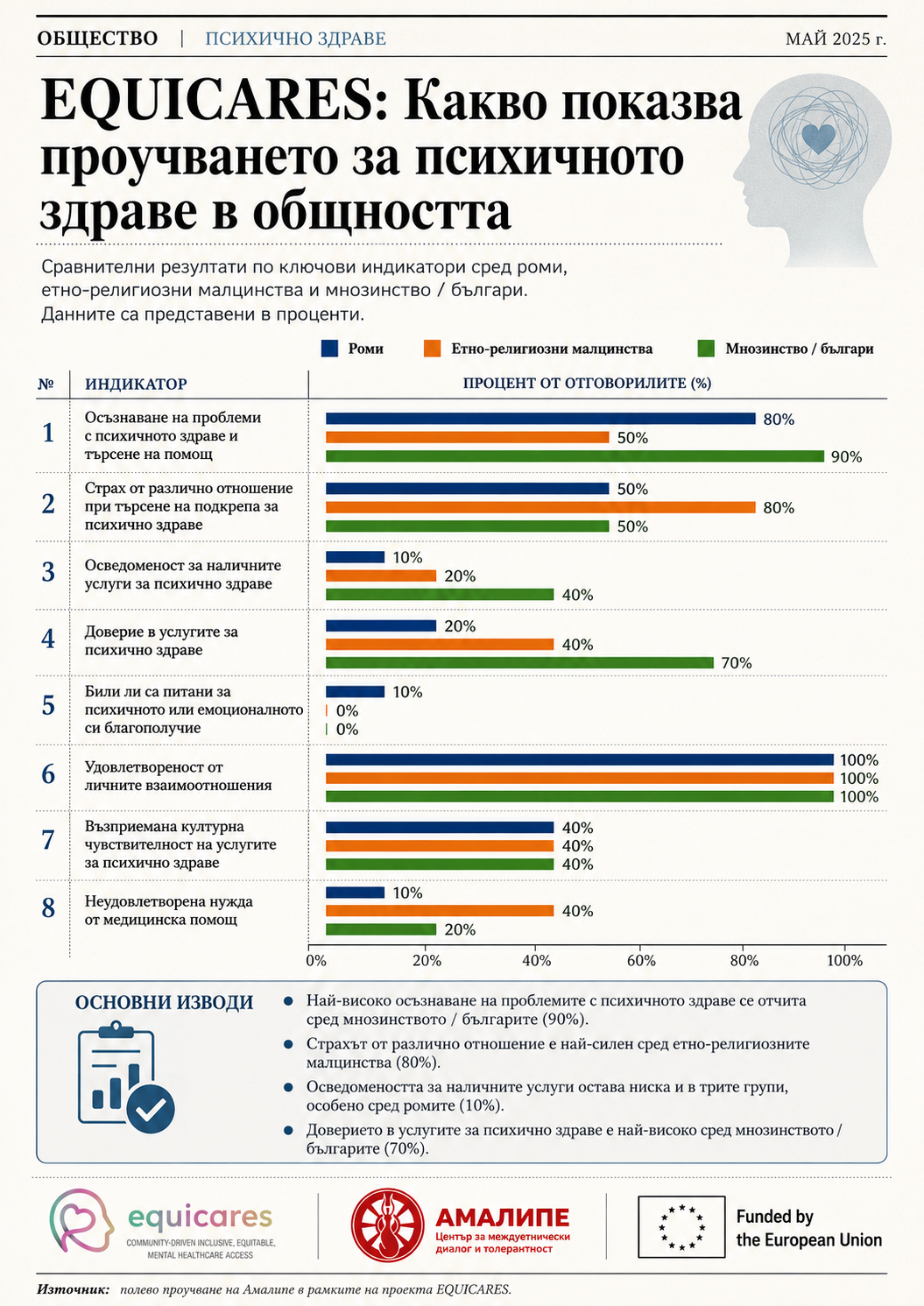 The majority of citizens of Veliko Tarnovo region (Pavlikeni and Strazhitsa municipalities) are aware of the need for specialized help in case of mental health problems. At the same time, there is a lack of knowledge about the available services in this regard, with a statistically significant difference between Roma and other minorities on the one hand and the majority on the other. Another significant difference is regarding trust in mental health services – among Roma and other minorities it is significantly lower than among the majority. A large part of citizens also share a fear that they will be treated “differently” if they seek mental health services.
This is shown by data from a survey conducted by the Amalipe Center in February-March among 210 citizens of the Pavlikeni and Strazhitsa municipalities. It included three groups – Roma, other ethno-cultural minorities and Bulgarians, divided equally (70 representatives of each group).
The study shows that 90% of ethnic Bulgarians and 80% of Roma declare that they have no hesitation in seeking specialized help in case of mental health problems. Among other ethno-cultural minorities (Turks, Millets, Miners, etc.) this percentage is lower – 50%. Of course, the answer to this question refers to a stated desire to seek specialized help, without it being clear whether the potential user has a clear idea when they are facing mental health problems.
Also striking is the concern/fear that a person may be treated “differently” if they seek help for their mental health. Such a fear is shared by half of the surveyed Roma and representatives of other minorities, as well as 4/5 of the surveyed Bulgarians. It is obvious that deep-rooted concerns that those seeking help will be stigmatized (in the community, in the macro-society and before various institutions) continue to have their impact and additional campaigns and efforts are needed to overcome them. It is significant that the fear is particularly strong among citizens with higher education and better social realization.
Despite the stated desire to seek help for problems, the citizens of Pavlikeni and Strazhitsa are not aware of the available mental health support services. The figures in this regard are startling – only 10% of Roma and 20% of other minorities know what services are available. Among ethnic Bulgarians, this percentage is also not high – 40%. Targeted activities and campaigns are needed to familiarize citizens with the mental health support services that they can use.
Trust in the quality of these services is low among Roma (20%) and other minorities (40%). Only among the ethnic Bulgarian group does trust prevail (70%). Whether this is due to lower quality in the Roma community or to experiences of discrimination is difficult to assess. In any case, targeted campaigns should be carried out among Roma and minorities to overcome mistrust and the quality of these services should be strengthened.
Additional indicators confirm the need for closer and more understandable support in the community. Participants in all three groups report high satisfaction with their personal relationships, but only 40% believe that mental health services are sufficiently sensitive to people’s cultural beliefs and practices. At the same time, some of the respondents also share an unmet need for medical care, with this problem being most pronounced among other ethno-cultural minorities.
Based on these results, as part of the Equicares project, the Amalipe Center is starting work on the creation of so-called “Meeting and Support Places” in the municipalities of Pavlikeni and Strazhitsa. They will be spaces for conversation, sharing and referral to support, rather than formal offices or institutional services. In parallel, an online and offline information campaign will be held to promote these places and encourage people to talk more openly about stress, difficulties and seeking help. The first events will take place in Varbovka and Tsarski Izvor – on May 21 and 22, respectively.
Within the framework of the EQUICARES project, a roundtable on the topic of “Mental Health without Barriers” will also be held, which will take place on June 5 in the municipality of Veliko Tarnovo. The event will bring together representatives of institutions, local authorities, specialists and organizations to discuss the main challenges to access mental health support, the stigmas and barriers that different communities in Bulgaria face.
