

Center Amalipe publishes report “Early Marriages in Roma Communities in Bulgaria: Trends, Factors and Paths for Change”
Center for Interethnic Dialogue and Tolerance “Amalipe” has prepared a report “Early Marriages in Roma Communities in Bulgaria: Trends, Factors and Paths for Change”. The document offers an in-depth analysis of early marriages in Roma communities in Bulgaria, combining desk research, collection and analysis of qualitative and quantitative data, focus groups and field observations, presenting the rich field experience and good practices of the Center Amalipe over the years for the prevention and response to cases of early marriages. It examines how traditions, poverty, low education, social isolation and distrust of institutions maintain the practice, as well as what consequences it has for the health, education and social integration of Roma girls. The report formulates specific recommendations to state institutions, the educational system and local communities for the prevention, support and empowerment of girls at risk. It provides practical guidelines for activities that lead to the prevention of early marriages in different Roma communities.
The report was prepared within the framework of the project “Marriage Can Wait, Education Can’t”,
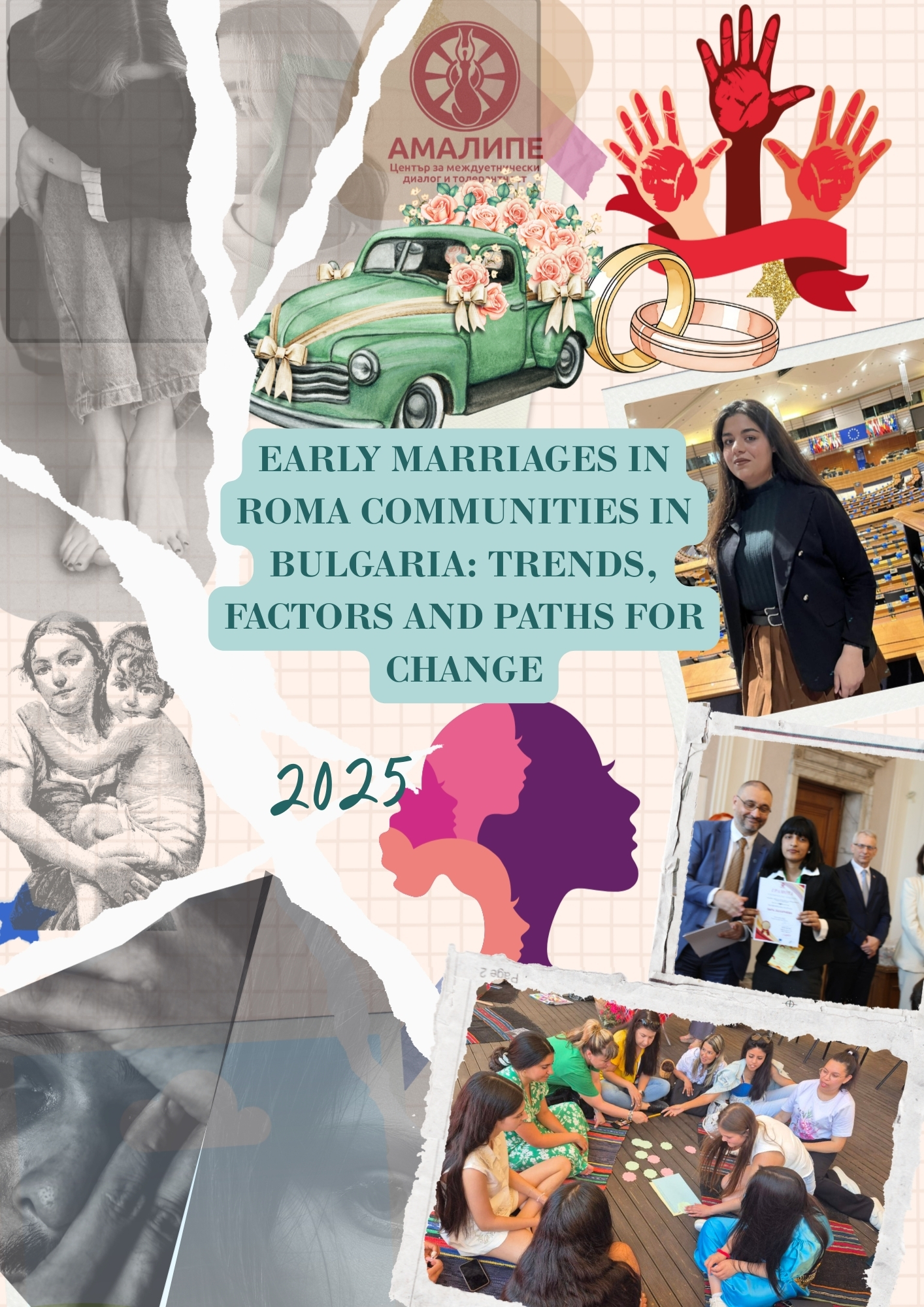
which aims to counteract the practices of early cohabitation and marriage among the Roma community by promoting education, gender equality and the protection of children’s rights, with a focus on girls. The project combines research, the development of innovative educational and digital tools, active work with communities and institutions, as well as advocacy at the political level. Its approach is intersectoral and integrated – covering both institutional mechanisms and the internal dynamics of communities, working directly with young people, parents and informal leaders.
The key topics examined are:
- factors leading to early marriage (poverty, social norms, lack of perspective and education);
- regional and group differences in the prevalence of the practice;
- the changing motivation – from parental imposition to choice by the youth;
- the challenges facing the institutional response and inter-institutional cooperation;
- good practices for prevention and empowerment of girls.
The document highlights the serious consequences of early marriage – on the health, education and social integration of girls – and formulates specific recommendations for state institutions, the education system and local communities. These recommendations aim to support the creation of effective policies and prevention mechanisms based on evidence and the active participation of the Roma community. The report also serves as a starting point for future advocacy efforts aimed at sustainably reducing early marriages and promoting education as a lasting path to change.
“In July, the Ministry of Labor and Social Policy (MLSP) and the State Agency for Child Protection (SACP) launched a national initiative, officially declaring early marriages and early motherhood as one of the main priorities in the state policy for children. The reason for this was alarming statistical data: according to the MLSP, over the last decade, over 33,000 children were born to underage mothers, and in 2024 alone, the number of live births to minors reached 2,837. In a series of public statements, including by Minister Borislav Gutsanov, the institutions acknowledged the scale of the problem, calling it a “social bomb” and called for immediate action. A series of national meetings were organized.”
In this context, the project “Marriage Can Wait, Education Can’t” and the report prepared within its framework come at a key moment and fit directly into the priorities of national policy, by offering solutions based on evidence, community participation and innovative tools for prevention. By implementing proven practices on the ground, it has the opportunity to make planned policies and activities even more adequate and oriented towards the needs and requirements of local communities, schools and young people. At the very beginning, Amalipe Center was the only civil society organization included in this process, which gave us the opportunity to be a corrective to the prepared policies and to ensure that they do not turn out to be yet another discriminatory practice against Roma children and Roma girls in particular. Against this background, the report provides valuable, timely and analytical information that can assist both specialists and organizations working in Roma communities, as well as competent institutions in their efforts for effective prevention and support.
Authors: Assoc. Prof. Dr. Alexey Pamporov, PhD Anna Velikova, Teodora Krumova, Deyan Kolev.
For more information about the activities carried out within the project, see HERE
The report was prepared within the framework of the project “Marriage can wait, education can’t” is implemented within the framework of the INSPIRE project: Improving National Support for Prevention, Intervention, Response, and Empowerment of Victims of Violence against Children” and is co-funded by the European Union and the Foundation “Workshop for Civic Initiatives Foundation” (WCIF).
