

The challenges facing the Education Program and its changes: sixth meeting of the Monitoring Committee
The Monitoring Committee of the Education Programme held its Sixth meeting, at which it approved the creation of a new special Priority 5 “Civic Preparedness in the Education System”, aimed at increasing the knowledge and skills of students and teachers for protection and response to crises. The new operations and systemic projects that are yet to be announced, the development of the programme, and how NGOs and educational institutions can participate in it more effectively were discussed. What did the Monitoring Committee decide?
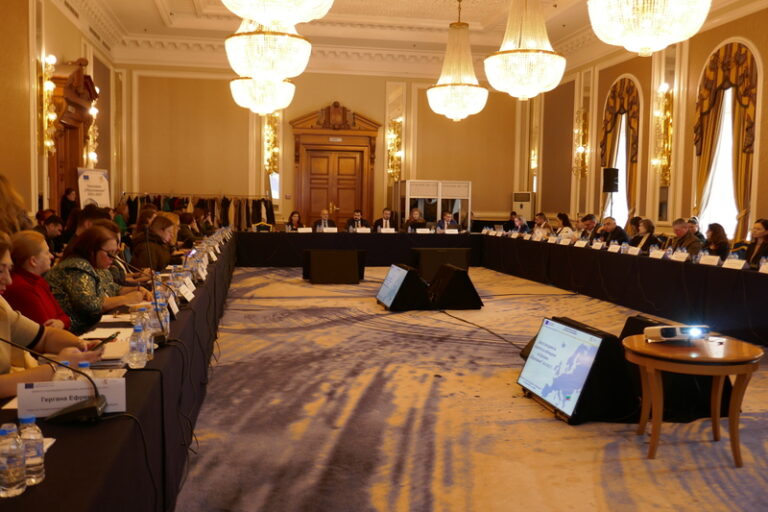
The meeting of the Monitoring Committee for the PO was held on 25.11.2025. in the city of Sofia. It was chaired by Ivan Popov, Executive Director of the EAPO. The meeting was attended by Deputy Minister Petar Nikolov, representatives of the European Commission, the Ministry of Education and Science and other institutions relevant to the implementation of the program. The group of organizations working for the educational integration of vulnerable groups was represented by Deyan Kolev from the Center “Amalipe”.
The meeting discussed numerous issues relating to:
- The current implementation of the Education Program: It became clear that 24 procedures have already been announced with a total amount of funds of BGN 1,896,164,135.62, or 100.47% of the total budget of the program. Currently, 904,984,901.97 leva have been agreed, or nearly 50% of the total value of the program, and the funds paid amount to over 305 million leva. The delay in the agreement and implementation of the program is largely due to the still unstarted implementation of two of the large systemic projects of the Ministry of Education and Science, relating to the development of the competency model in education and digital education (continuing the project “Education for Tomorrow” from the transitional programming period). The first of them was approved by the Monitoring Committee back in 2022, but after a long delay, its real start will be in 2026. The project for digital transformation in education has not yet been finally agreed with the Ministry of e-Government, which is delaying its start.
As a result of these delays, there was a real risk of loss of funds (under the n+3 rule). The Managing Authority managed to reduce it to 28 million leva, which will be transferred to the Food and Basic Material Assistance Programme 2021-2027. The other step that will avoid the loss of funds, or their transfer to another programme, is the creation of a new priority focused on civic readiness in education;
- The Committee approved the targeting of Priority 5 “Civic Preparedness in the Education System”, aimed at increasing the knowledge and skills of students and teachers for protection and response to crises. The new priority provides for practical training and activities to strengthen the civic capacity and preparedness of educational institutions in emergency situations. The priority will finance school and out-of-school activities to prepare students and teachers for crisis responses, such as earthquakes, fires, floods, terrorist threats, military operations. It will finance teacher training, discussions, interest activities, camps for acquiring civic preparedness skills, etc. The program will allocate financial resources of 84,614,708 euros/165,491,985 leva for the implementation of this priority.
Specifically, it is envisaged that the priority will be implemented by schools as specific beneficiaries (a model that will be similar to the operation for the prevention of aggression and bullying in schools, currently being implemented). There will also be an operation implemented by the Ministry of Education and Science, under which facilities for out-of-school camps will be renovated, the necessary software will be purchased, etc. An operation for the competitive selection of NGO projects will also be implemented.
During the discussion, Deyan Kolev drew attention to the fact that currently schools are engaged in numerous interest-based activities (from the state budget, national programs, systematic projects of the Ministry of Education and Science, etc.), and in the smaller ones there are not enough free students and teachers. On the one hand, this is wonderful and provides a chance to include students in a very wide range of activities that develop their abilities. But on the other hand, it is difficult to expect the new Priority 5 to be implemented solely through interest-based activities. There will certainly be great interest in out-of-school camps, especially if they are implemented in an attractive way for students. The Education Program must also provide for an appropriate scheme for financing this type of camps, so that there is sufficient resource for transport, food, materials, etc. In response, experts from the Education Program Executive Agency assured that this will be done and the current scheme “60% remuneration for labor plus 40% for other direct and indirect costs” will not be followed.
- The latest developments in all systemic projects of the Ministry of Education and Science were presented (Success for You, Strong Start, etc.). The completely innovative project for dual training in higher education, the new Student Practices, etc. aroused interest. The first 15 projects have already been submitted under the currently ongoing procedure for applying for school projects for the prevention of aggression and bullying, and the filling in of nearly 200 others has begun in the UMIS. Since each school is a specific beneficiary, the evaluation of the first projects has already begun. It is not too late for schools to start submitting their project proposals, as financial resources are still available.
- Deyan Kolev raised the issue of artificial obstacles that hinder the participation of civil society organizations. He emphasized the lack of an advance if NGOs apply. Until 2023, operational programs provided advances against a “Promissory Note” and this was a widespread practice. After this year, NGOs should provide a bank guarantee or collateral to receive an advance. As a result, organizations stopped applying and this leads to low implementation of entire operations. For example, under the competition for desegregation, only 27 projects were approved – from schools and municipalities and none from NGOs, and the operation absorbed only half of the allocated financial resources.
See the entire speech here:
In response, Ivan Popov indicated that the Ministry of Finance has discussed the recognition of advance insurance costs as eligible project costs or their coverage by the Ministry of Finance. He indicated another solution that will be implemented by the Education Program: For a project up to 200,000 euros, reporting should be done on milestones, the first of which should be the creation of a team and an action plan.
Participants also discussed numerous practical issues that hinder the full implementation of the program. For example, the difficulty of collecting personal data (especially the personal identification number) from parents and the need to eliminate this requirement was raised.
The Committee approved the Indicative Annual Work Programme for 2026, which includes the upcoming competitions.
See more:
The budget for school projects for the prevention of bullying and violence: what do we need to know?