
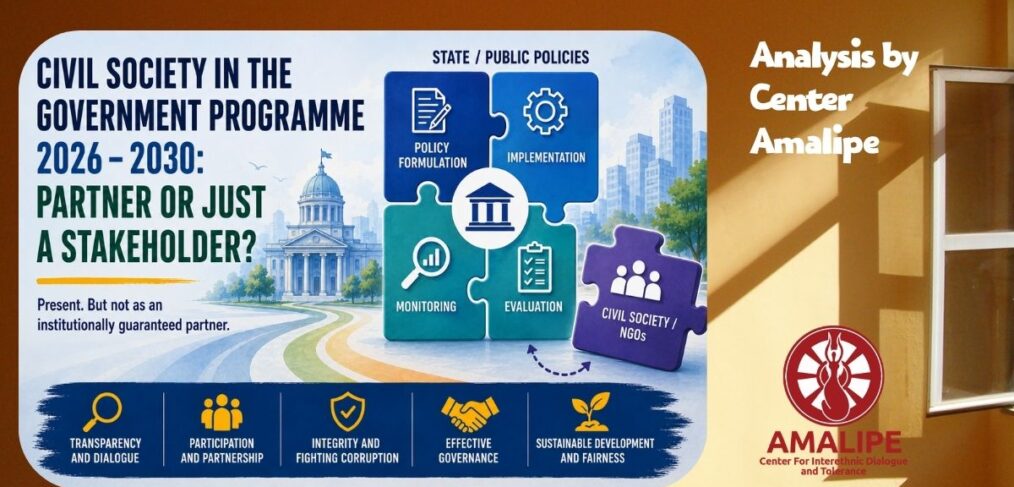
Civil Society and NGOs in the 2026–2030 Governance Programme: Partners or Merely Participants?
The Government’s Governance Programme for 2026–2030 contains a number of commitments to transparency, dialogue, combating corruption and many other issues. These are largely framed as tasks for public institutions. Even a cursory review of the Programme – a 208-page document covering almost every sphere of public life – shows that civil society is not identified as a distinct priority of governance, while non-governmental organisations are viewed primarily as partners or merely participants in specific sectoral policies. There is no horizontal policy for the development of civil society or for institutionalising its participation in the formulation, implementation and monitoring of public policies. Is this omission accidental, and what can be done to promote civic participation over the next four years?
When analysing government governance programmes from the perspective of the place afforded to NGOs, it should be borne in mind that civil society organisations have been “far from favoured by politicians” for many years. The latest “five-year period” has reached new heights in this respect. Regulatory and legislative acts have been adopted which, in one form or another, restrict NGO participation in important areas of public life – education, for example, among others.
Thus, on 7 August 2024, by a large majority and within a single day, the National Assembly voted through amendments to the education law – the Pre-school and School Education Act – which became known as the “anti-LGBT amendment”. Even then, it was clear that one of the aims was to restrict “NGO interference” in schools.
Shortly afterwards, the anti-European Revival party proposed the adoption of a Foreign Agents Registration Act (FARA), which would result in most civil society organisations being registered as “foreign agents” and prohibited from operating in the field of education – a bill that the party has continued to reintroduce periodically ever since. The Movement for Rights and Freedoms (MRF) proposed the establishment of an “Anti-Soros Committee”.
Although these proposals were rejected on 5 February 2025, many Members of Parliament merely abstained. The Anti-Soros Committee was later supported, although in practice it never began operating. In any event, the legislative and public environment in which civil society organisations operate can hardly be described as favourable.
The Radev Cabinet’s Governance Programme was prepared in precisely this environment. It does not represent any major departure from the overall negative tone.
NGOs are mentioned in several specific areas. For example, the anti-corruption policy envisages an exchange of good practices on transparency and combating corruption with academia and the non-governmental sector. In the field of cybersecurity, the Programme provides for expanding the national cyber community to include NGO representatives, while in the area of addiction prevention it envisages a sustainable mechanism for cooperation with the non-governmental sector. In other areas, the Programme refers to dialogue with civil society in the preparation of regulatory changes.
This shows that NGOs are recognised as a valuable source of expertise and a valuable public resource, but their participation is envisaged only in a fragmented manner and depending on the specific policy area. Why is this not provided for across all sectors?
The answer is most likely related to the way in which the Government’s Governance Programme is prepared. As a rule, the different ministries and responsible institutions draft the respective sections of the Programme, including the activities they are already implementing or planning to implement. This also includes partnerships with organisations, universities and others. The fact that NGOs are mentioned only in certain areas of public life may indicate the fields in which civil society organisations are recognised as a source of expertise and a public resource. It may also indicate the presence – or absence – of political will for genuine partnership with NGOs.
Of particular importance is the fact that the Programme does not turn the Civil Society Development Council (CSDC) into an institutional mechanism of governance. The CSDC is not identified in the Programme as a partner or as a body through which the state will conduct systematic dialogue with the civil society sector. Nor is there any measure aimed at strengthening the Council, developing its administrative capacity, or ensuring the conditions necessary for its effective functioning.
This is a significant omission, as the CSDC could serve precisely as the institutional link between the executive branch and organised civil society.
It should be pointed out that the Civil Society Development Council (CSDC) is the institutionalised mechanism for dialogue and interaction between civil society and the state, established by law as an advisory body to the Council of Ministers. Its institutional significance stems precisely from the fact that it is not merely an informal platform or an NGO consultative forum, but an officially recognised body through which organised civil society can participate in the formulation and implementation of state policies.
The Council has a mandate to discuss and issue opinions on matters related to the development of civil society, formulate proposals to the Council of Ministers, and participate in determining the priorities and mechanisms for state support to civil society organisations. Of particular importance is the fact that its membership is determined through the election of representatives of the civil society sector, while the Council itself is constituted and operates within the framework of the Council of Ministers.
Thus, the CSDC represents an institutionally recognised channel for civil society participation in governance – and it is precisely because of this role that its absence from the Governance Programme is significant when assessing the Government’s approach to the civil society sector.
This is even more surprising given that the latest composition of the CSDC was elected in April 2025, with 150 organisations participating in the election. The current Government appointed Deputy Prime Minister Ivo Hristov as Chair of the CSDC. The absence of a dedicated section on civil society development – and even the failure to mention the CSDC at all – is a cause for concern.
The unfortunate fate of the CSDC is not an isolated case. For years, another Council intended to facilitate consultation with civil society has suffered a similar fate – the National Council for Cooperation on Ethnic and Integration Issues (NCCEII).
As its name suggests, it is intended to facilitate interaction between executive institutions and civil society organisations representing minorities. Its Rules of Organisation and Procedure were approved by a Decree of the Council of Ministers, and it is chaired by a Deputy Prime Minister (Ivo Hristov has been appointed to this position).
However, since 2013, almost all Roma NGOs have withdrawn from the NCCEII, criticising its largely formal activities and proposing reforms. Although many governments have changed since then – I would rather not give an exact number, as the risk of getting it wrong is rather high, but we are talking about around 16 governments – and numerous Deputy Prime Ministers have been appointed as Chairs of the NCCEII (including the extreme nationalist Valeri Simeonov), no genuine reform of the Council has taken place. Discussions have begun repeatedly but have never been brought to a conclusion.
The current Governance Programme does not even mention the existence of such a Council. Not only does it contain no specific new policy regarding the NCCEII; it also does not envisage reforming it so that it has genuine powers, can effectively coordinate and consult with the civil society sector, and thereby attract active NGOs back into its work. The Programme does not answer the question of what the institutional mechanism for coordinating policy on ethnic and integration issues will be.
Another important issue is civil society participation in the drafting of regulatory acts. The Programme contains positive language concerning an “open dialogue” with civil society. In environmental policy, for example, the participation of businesses, municipalities, the scientific community and civil society is envisaged in the preparation of regulatory changes.
This is an important commitment, but it is framed as sector-specific consultation, rather than a general principle of governance. There is no provision for civil society or the CSDC to be systematically involved in preparing all regulatory acts affecting public relations. Such participation is a statutory requirement in relation to both the CSDC and the NCCEII, but, as noted above, both Councils are entirely absent from the Government’s Governance Programme.
The Governance Programme therefore proposes a model in which civil society is a stakeholder that is consulted to a certain extent – and only in some areas – but is not a clearly institutionalised equal partner of the state.
The distinction is significant. Consultation means that the state develops a policy or legislation and then seeks the views of stakeholders. Partnership means that civil society organisations participate from the outset – in identifying problems, formulating solutions, implementation, and evaluating results.
In conclusion, civil society participation can be viewed as a spectrum comprising five levels: information, consultation, involvement, cooperation/partnership, and delegation of powers. The Governance Programme provides for certain forms of information and consultation and, in some places, refers to dialogue and cooperation.
What is missing, however, is a clear horizontal commitment to involve civil society organisations as partners in policy formulation, let alone to delegate powers or responsibilities to them for the implementation of those policies.
This does not apply only to the current Government and its Programme. Unlike some other European countries, Bulgaria has consistently refrained from delegating powers and responsibilities to civil society organisations. This is a serious weakness that leads to unsatisfactory results in some key areas of public life.
(Hardly anyone can deny the positive role of NGOs in education or the fact that many of the most successful initiatives began as activities of civil society organisations. Nevertheless, NGOs are not delegated responsibilities in the field of education. The situation is similar in other sectors.)
What Should Be Done?
First, the CSDC and the NCCEII should be transformed into genuinely functioning mechanisms for institutionalised dialogue between the state and civil society. This means not merely their formal existence, but clear rules for participation, administrative and expert support, and regular communication with the Council of Ministers.
These Councils should participate effectively in the coordination procedure for acts of the Council of Ministers relating to the development of civil society and to ethnic and integration issues respectively. A culture of consultation with these Councils must begin with the Government itself. The current Governance Programme gives little cause for optimism, but this can be changed.
Second, a horizontal mechanism for civil society participation in the development of public policies and regulatory acts should be introduced. This does not mean that every NGO should participate in every bill. Rather, the CSDC and representative organisations should have a guaranteed opportunity to participate at the appropriate stages of the process – when problems are identified, concepts are developed, impact assessments are prepared, draft regulatory acts are formulated, and subsequent evaluations are carried out.
Of course, executive institutions must also change their overall dismissive attitude towards civil society organisations and actively encourage civic participation in their initiatives. This does not concern only the CSDC and the NCCEII – it would be dangerous for these bodies to monopolise the channels for civic participation. Institutions must provide opportunities for the meaningful participation of all active organisations working in the relevant field.
Third, in the programming and management of EU funds, the partnership principle must be preserved and further developed. NGOs should be viewed not only as potential applicants for funding, but also as holders of expertise and representatives of the public interest in the programming, monitoring and evaluation of European investments.
Fourth, a targeted policy for the sustainability and development of the civil society sector is needed – including organisational capacity development, access to funding, volunteering, civic participation and mechanisms for public-private partnership.
The Government can and should invest in the development of the civil society sector through EU programmes – particularly those co-financed by the European Social Fund Plus (ESF+), which contains an investment priority in this area – as well as through the national budget.
The latter is even provided for by law, yet for years the minimum funding allocated for NGO projects has remained unused – BGN 1 million annually, which is not utilised because the executive branch does not launch the mechanism through which it could be distributed. The Radev Cabinet’s Governance Programme envisages no action in this direction.
Fifth, it would be in the interest of society as a whole – not only NGOs – for the executive branch to delegate to civil society organisations with proven capacity certain powers and responsibilities for the implementation or co-implementation of important activities in the main areas of public policy.
This would also require the development of a mechanism for monitoring and quality control of implementation. In any event, it is worth investing in the involvement of NGOs rather than relying solely on institutions.
In conclusion, the main problem with the Governance Programme is not that it completely ignores civil society. It recognises civil society – but primarily as a stakeholder and a source of expertise in certain areas.
What is missing is the next step: recognising organised civil society as an independent and institutionally guaranteed partner in democratic governance. This should be one of the important priorities in the further development of the Programme and in the preparation of policies for the period after 2027.
Author: Deyan Kolev
See also:
The Radev Cabinet’s Governance Programme – What Does It Envisage for EU Funds?
Images are generated using AI