

Intercultural education across borders: lessons from Peru (part 3)

Although part of the same country, the Costa and the Sierra of Peru are the two opposite sides of a world that is as colorful as the colors of the mountains. And while Lima suffocates you with dust, traffic, shadow people, the incessant sound of horns and the inability to take a breath, even if there is no problem with oxygen, landing in Cusco, you suddenly find that you can breathe again (despite the altitude). The city dazzles you with its pure, sparkling colors (especially when you arrive at the height of the rainy season and all the vegetation has revealed its brightest and freshest green, and the sky is the color of the bluest magic). At some point, people become human beings again and you start to breathe with the rhythm of past and present, which fascinates you, takes you through the street graffiti that tells stories from every wall, teaches you about reciprocity, about belonging, and at the same time makes you feel at home.

The Andes is a region that is not easy – you start to feel the lack of oxygen, the terrain is challenging and in the big cities like Cusco and Puno the houses, just like in Tarnovo, are perched one on top of the other on the hills. Transportation is a challenge (both public and private) and what you need most is strong legs and strong lungs. Maybe that is why I saw almost no one smoking. The air is so thin that even cigarettes do not burn properly, but the locals rarely touch tobacco either – the leaves, which they chew and drink as tea, have a much wider range of uses and are the best remedy for altitude sickness.
The infrastructure is also a challenge, although it turned out that for a person with a wheelchair, the sidewalks are much more adapted than in Europe – there are sloping sidewalks everywhere, so you can get on and off them without any problems (if you can cope with the steep streets). There is some special ingredient in the air – it makes everyone help. Or people are just fed up with it. And something we have convinced ourselves – the harder people live, the wider their hearts are and the greater their willingness to help and share with you even the little they have. There are people everywhere who will gladly help you – they compensate for all the stairs and inaccessible environment, where there is one. Here people are so used to dealing with all the challenges that they don’t even think about them – they just roll up their sleeves and get the job done – there is no moaning, complaining or grumbling. And the more you grumble, the more you waste precious oxygen.
During our entire stay in the Andes, we did not see a single woman with empty hands. They always carry something – luggage, children, their fate… In the Andes, everyone carries their luggage not in bags, but in huge duffels, which women usually tie across their chests. We did not see any men with similar luggage…

The Andean regions, especially the Southern and Central Andes, are the real center of intercultural bilingual education (IBE) in Peru. By the way, a large part of the indigenous population (especially the Quechua and Aymara peoples) live precisely in the Andes. The school network there includes thousands of schools and kindergartens, most of which are attended by a small number of children and students. Accordingly, there are also thousands of intercultural bilingual schools (IBU), they make up a large part of the educational institutions there. For example, IBU are the majority of schools in the regions of Apurimac (2325 out of a total of 2548, i.e. 91%), Ayacucho (2968 out of a total of 3393, i.e. 87%), Puno (4501 out of a total of 5902, i.e. 76%), Cusco (3332 out of a total of 4920, i.e. 68%), Huancavelica, Ancash. There are also a large number of IBUs in the regions of the Northern Andes, as well as in the Amazon. It is important to emphasize that most intercultural schools are located in villages, but increasingly such schools are being formed (i.e., given status) in cities, including large cities such as Cusco, Puno, Juliaca, and others. Usually these are small schools (i.e., with a small number of students), combined classes, with few teachers (with one teacher teaching several subjects) and relatively poor material resources. In general, schools in Peru that educate children from indigenous communities face serious problems with attracting quality teachers, especially schools outside large cities. Very often, teachers have to travel within a radius of about 50-60 km, without receiving additional incentives for this or having their travel expenses covered. The vast majority of IBSs (95-99%) are public, and private IBSs are isolated exceptions.
The IBS (as well as most other schools in Peru) is funded by the state budget – through the Ministry of Education and regional governments. In Peru, there is no funding based on the number of students (this would greatly harm small schools and would lead to the closure of most of them), but a more complex system that includes the number of students, teachers and the basic needs that educational institutions need. There is a widespread complaint that the funding only covers the most basic needs of schools – teachers’ salaries, maintenance of the school building (partially), teaching materials and, partially, lunch for students. Local communities supplement this funding, including through building maintenance, repairs, additional products for lunch and participation in its preparation, and a number of others. There is no guaranteed transportation to schools and students are required to manage this themselves (in mountainous areas, where transportation is generally difficult, students usually walk). It can be said that parents and the entire local community actually support the work of schools. In many cases, the school’s funds are enough to purchase products, and the mothers take turns cooking them and helping with serving.

Visiting schools in the Andes and talking to local people about them, we often had a sense of the state of the school network in Bulgaria before its optimization, that is, before 2007-2008. Although we have repeatedly criticized the initial optimization process in 2007 (the introduction of delegated school budgets based solely on the number of students at low levels of the uniform spending standard per student), which led to the closure of hundreds of schools in the villages (500 schools in two years), we cannot deny that it also had positive effects. Middle schools were stabilized, the state ensured free transportation for students and full-day organization of the educational process, including free lunch. In addition, funds for education and for schools in general were gradually increased.

Peru is far from such a process and it is uncertain to what extent it can happen, especially in the Andes. The terrain would hardly allow for transportation of students (many of the villages are isolated and without real road connections, and in some parts of the Andes families also live scattered), the majority of schools would have to be declared “protected” (that is, their closure should not be allowed and the state should finance them according to the necessary expenses)… In any case, a complete reform of the school network would be very painful, requiring serious additional funding (Bulgaria uses a large resource from European funds, which is not available to Peru), the permanent political crisis of recent years would also not stimulate such a political move. In addition, the area of the Andes and the Amazon is many times larger than the territory of Bulgaria. Under these conditions, it is understandable that funding from the state budget is extremely insufficient.
As we pointed out in another article, IBSs do not receive additional funding for being intercultural bilingual schools. The budget provides a small additional resource for schools in remote areas (far from what is needed to attract better-quality teachers), but there is no specific resource for intercultural educational institutions. In fact, the state allocates such resources primarily for the preparation of teaching materials in local languages and other related costs, but not for additional payments to teachers in local languages. An important condition for a school that wants to be an IBU is that the school has qualified bilingual teachers. This does not bring the school an additional financial standard, and the funding of these teachers must come from the general budget and often it is at the expense of another teacher. Naturally, this creates competition in schools and is one of the reasons why in large cities, where, no matter how large the number of migrants from the Andes and the Amazon is, they are small as a percentage, there are also a small number of bilingual schools. In this regard, the experience from Bulgaria of providing additional funding (which cannot be used for anything else) for schools with a concentration of vulnerable groups (Art. 52a of the Funding Regulation), which includes the salaries of educational mediators and additional funding for teachers’ salaries, would be particularly useful. In all educational institutions where we presented this experience, it aroused particular interest.

In Peru, the profession of educational mediator is practically unknown, although there is definitely a need for it. Part of the culture of indigenous peoples includes volunteering for others and for the community (part of the principle of reciprocity, known by its Quechua name Ainu). Parents from the community often support educational institutions and children – for example, they accompany students from a given village to the school, which may be more than an hour away on foot, cook lunch at school, and many other things. They do this on a voluntary basis and of course – there is no way to expect this help to be as systematic and comprehensive as the help of the educational mediator. In this regard, the Bulgarian experience can also be very useful. Since the Amalipe Center is among the main advocates for the position/profession of educational mediator, we presented its benefits and this definitely aroused strong interest.
Intercultural bilingual education in Peru first appeared in the second half of the 20th century. At that time, it was part of the overall policy of assimilation of indigenous peoples (especially in the Andes) and their gradual transition to education entirely in Spanish. In practice, until the beginning of the 21st century, the Peruvian state was trying to purposefully “integrate” Quechua and Aymara by erasing their specific identities, and intercultural bilingual education (then primarily bilingual and to a much lesser extent intercultural) was one of the means to do so.
In the 21st century, a cardinal change in this state policy occurred. One of the reasons was the approval of international agreements that obliged Peru to make targeted efforts to preserve the identity of indigenous peoples, part of which was the introduction of intercultural bilingual education (Convention 169 of the International Labor Organization, the UN Declaration on the Rights of Indigenous Peoples, etc.). Initially, this was not a strong enough incentive: for example, the governments of President Fujimori at the end of the 20th century tried to circumvent the International Agreements with the argument that “pueblos indigenas” were only the peoples of the Amazon, and the Quechua and Aymara were “campesinos” i.e. peasants, without this category having ethnic specificity and leading to collective rights, including the right to identity (this direction was set by General Alvarado’s agrarian reform in 1975). But the gradual mobilization of indigenous communities, especially in the Southern Andes, has had a wide range of political consequences, including the election for the first time in Peruvian history of presidents from among indigenous peoples (Alejandro Toledo, Oyanta Humala, Pedro Castillo) and a rethinking of the IBO as a means of preserving identity. This mobilization is not as large-scale as in neighboring Ecuador and Bolivia (the reasons for this are many, including the terror against Quechua and Aymara by the Sendero Luminoso and the Peruvian army in the 1980s…) and as a result, the IBO in Peru is promoted and controlled primarily by the state and, to a lesser extent, by local communities. This is one of the differences compared to Ecuador and Bolivia, where indigenous peoples and their organizations have a much more active role in the process. But in any case, we can confidently say that in the twentieth century, IBE in Peru followed the paradigm of preserving and renewing the cultural identity of indigenous peoples, including Quechua and Aymara. In the Andes, where the process of cultural revival is particularly strong, IBE gradually became a leading educational trend. In Lima, this is not the case – the assimilationist trend there continues to be strong and no suitable forms of IBE have been found.
Another important reason for the Peruvian government’s support for IBE in the Andes is the high dropout rates and the lower quality of Spanish-language education among indigenous peoples. Over the years, intercultural education has proven to be a means of building bridges to parent communities and preventing dropout, both in Peru and in many other Latin American countries.
With all this in mind, we headed to intercultural bilingual schools and universities in the Cusco and Puno regions. With us were our friends Carlos and Angelica from Cusco, Nayrut from UNESCO (Cusco), Reynaldo from Puno. We were also assisted by Wilfredo Quispe from the Regional Office of the Ministry of Education in Puno. We would like to thank them all very much!
Institución Educativa Santa Rosa de Lima, Urpay, Quispicanchi (Cusco Region)/ Secondary School “Santa Rosa de Lima”, Urpau village, commune. Quispicanci, Cusco Region
Institución Educativa Santa Rosa de Lima is a public school located in the rural community of Urpay (population 427), Quispicanchi Province, Cusco Region, Peru. The school has the status of an intercultural bilingual school, educating students from indigenous communities whose mother tongue is Quechua. It is part of the schools in the Cusco Region included in the Horizontes* program of UNESCO Peru, an initiative aimed at developing quality secondary education in rural areas. The program works to ensure that students not only complete their education, but also develop socio-emotional skills, a sense of identity, civic participation and real-life perspectives. Within the program, students participate in practical activities related to entrepreneurship, agriculture, local crafts and the preservation of cultural identity. Special emphasis is placed on the relationship between the school, the community and the local culture, so that education is closer to the real life of young people in the Andes.

The school is similar to the middle schools in Bulgaria. It is a typical example of the harsh conditions in which educational institutions in the Peruvian Sierra operate. It educates 202 students from 7 local communities/villages, some of which are really remote high in the Andes. For example, students from one of the villages have to walk at least an hour or an hour and a half to reach the school, and their way back up the mountain takes nearly three hours. The roads are “black”, they pass through forests and rocks, there is no transport and the students walk. They are often accompanied by a parent from the local community, who looks after all the children from it. And sometimes one of the older students leads the group. This happens daily. The teachers travel from Cusco, which is about 45 minutes away (once you get out of the traffic of the big city). There is no free transport for either the students or the teachers.
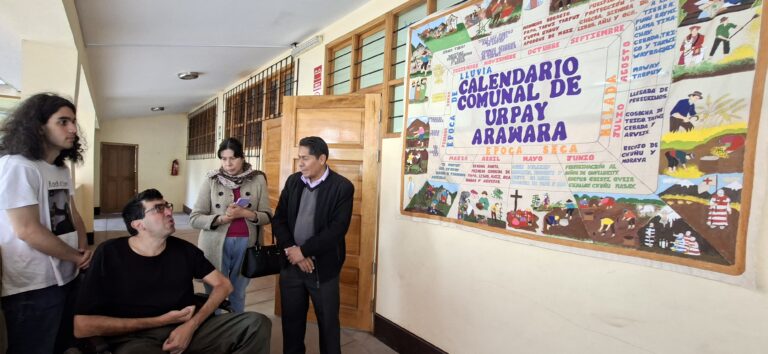
The material base impressed us as relatively good. Students in different stages are located in separate buildings. The school has a computer lab and free internet. A special program of the Peruvian Ministry of Communications provides free internet for schools and public buildings in the Andes and Amazon (The coordinator of this program is Manuel Diaz, who years ago completed his higher education in Bulgaria and still speaks good Bulgarian. We met him on the first day of our stay in Peru). There are wheelchair ramps between the different school buildings – the school maintains them, although there are currently no students with disabilities. The good material base is probably due to the fact that the school participated in the UNESCO Horizontes program, but it is a fact that the base looks very well maintained three years after the end of the project in the Cusco region. We visited two of the high school classes – one with a cooking profile, and the other with a “Graphic Design” profile.
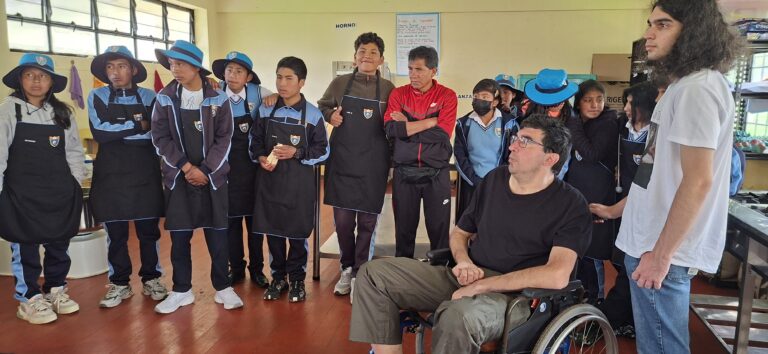
The conversations with the students touched on topics such as discrimination, identity, the desire for education and professional fulfillment. All students are from the indigenous Quechua people (direct descendants of the Incas, who live not only in Peru, but also in Bolivia and Ecuador, as well as in Argentina, Chile and Colombia), and they study this language for only two hours a week. The reason is the lack of enough teachers who have been trained as bilingual teachers. However, Quechua words and expressions are written everywhere in the classrooms and in the school. When we initially invited them to speak Quechua, the students were slightly embarrassed and did so only later. Talking (in Spanish), they explained that Quechua are often subject to discrimination based on dark skin, poverty and poor command of Spanish. At the same time, they are proud of their ethnicity – an important change that we have noticed in many places in the Andes. The school also has this policy of building/supporting the children’s identity and putting intercultural education into practice. For example, the cooking class includes many of the foods and products that are part of the life of the local community. One of these products is corn – it is an extremely important part of the life and ritual system of the local community. It is also an important part of the life of the school.
In the Graphic Design class, they were tasked with developing a digital marketing strategy for local small and medium-sized businesses within the framework of the Inka Vision concept. Both classes we spoke to were very excited that someone from the other side of the world had come and was interested in them. They were very curious to learn more about our youth, about the problems they face, and were surprised by how much they resembled each other, even physically. Radost Petkova’s photos moved them because they felt the connection with their peers across the ocean. And at the end of our meeting, they were already teaching us Quechua and Aymara and were happy to record a video message to our youth.
Here, as in the other schools we visited, the main approach in the school’s work is the creation of a community: a community that is based on the identity of families and the involvement of parents and the building of a strong connection between the school, the family and the community. Part of the construction of this collective identity of the school is the school calendar, which is painted in a visible place in the school, and students and teachers participate in its development. At its center is the school, and around it in three concentric circles by month are depicted the holidays of the school community, national holidays and holidays of the local community.

PUKLLASUNCHIS Secondary School, Cusco
Pukllasunchis School (the school’s name means “We Play” in Quechua) is a private school in Cusco, administered by the Pukllasunchis Association, one of the most recognized educational organizations in Peru in the field of intercultural and bilingual education. Founded in 1981 in Cusco, it develops a model that combines education, cultural identity, community participation, and active citizenship.
The school in Cusco educates approximately 800 children and young people – from kindergarten to high school. It is attended by children from different social and ethnic groups, with a predominance of students from Quechua-speaking families, children from the urban part of Cusco, as well as students from rural areas of the Andes. The school has a highly developed social policy, which includes attracting children from poor Quechua communities around Cusco, who are provided with scholarships to study at the school. One of the main principles of the school is the creation of a space in which cultural diversity is not only accepted, but becomes the basis of the educational process. In the center of the school, a waka (sacred place) has been created – a small lake with a rock in the center, where rituals and traditions related to Andean culture are celebrated.
Intercultural bilingual education at Puclásunchis is not limited to the study of Quechua and Spanish. The school implements a much broader model in which:
- Quechua is present in everyday communication and the learning process;
- traditional Andean culture is integrated into various subjects;
- students learn indigenous knowledge, cosmology, music, crafts and the connection with nature;
- the learning develops critical thinking, social engagement and intercultural citizenship.

The school community. One of the greatest strengths of Puclásúncis is precisely the creation of a vibrant school community, in which the school functions not simply as an educational institution, but as a cultural and social center. The campus is designed to encourage communication, creativity, and connection with nature. The architecture and organization of the environment are inspired by the Andean philosophy of community and connection with nature, rather than the classic “closed” school model. The school has:
- open spaces and gardens for common activities;
- amphitheatre and artistic spaces for performances;
- common spaces for meetings between children, parents and teachers.
It is important that at Pukljasunčis parents are not just “guests” of the school, but an active part of the educational process and school culture. This makes the school a kind of bridge between education, culture and community life.
Extracurricular activities. Particularly impressive are the practical and creative activities through which the school develops intercultural education. One of the initiatives that “Pucliasunchis” develops is the so-called “La radio en la escuela” (Radio in the school), through which children from Quechua-speaking communities create radio broadcasts in Quechua and Spanish. The students interview elders from the community, record stories, songs and traditions, and discuss current social issues. The radio is used as a tool for preserving the language and for building confidence and civic engagement in children. At the same time, it is part of the methodology for using the mother tongue to improve proficiency in the official Spanish language.

The school organizes theater performances, exhibitions, music and folklore events related to Andean culture. Through them, students explore their own identity and present the cultural heritage of their communities.
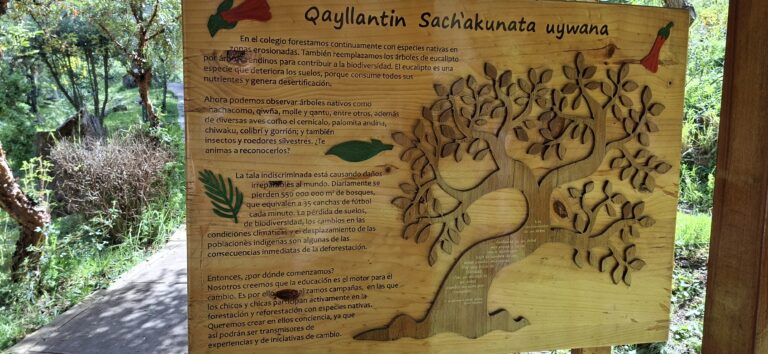
The Kawsay program (“life” in Quechua) connects environmental education with the traditional knowledge of local communities. Students work on topics such as sustainable agriculture, the human-nature relationship, and protecting the local environment. They have a teaching farm where they grow traditional Quechua plants and crops. The school also has a separate healing center with an adjacent herb garden. There, students grow herbs and other plants, study their place in traditional culture, how they are processed, and how they are used for healing. In this way, they include intercultural elements in biology classes, for example.
Teacher training. The organization also has a pedagogical institute for training future teachers in intercultural bilingual education. There, students are trained on how to teach in a multicultural environment and how to use local cultural knowledge as part of the educational process.
Pucllazunchis is often cited as an example of how education can combine academic development, cultural identity, and social change. His model has had an impact far beyond Cusco and is among the most recognizable practices of intercultural education in Latin America.
Titicaca/ Puno/ Urus floating islands

During our visit to the Puno region, we had the opportunity to visit a kindergarten located on one of the reed floating islands in Lake Titicaca. Our meeting gave us the opportunity to get to know up close how early childhood education is organized in one of the most isolated and peculiar areas in Peru. The kindergarten plays an important role not only as an educational institution, but also as a center of the local community.
The training covers children between the ages of 3 and 5 and is organized in mixed age groups. The reason is the relatively small number of children on the individual islands, which makes it impossible to form separate groups for each age.
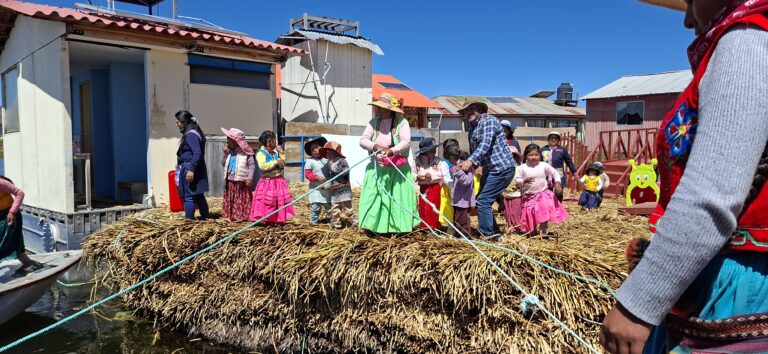
The learning process follows the national curriculum for preschool education, but is adapted to the local context. Great attention is paid to learning through play, motor activity, the development of language skills, socialization and the building of practical competencies. A significant part of the activities are related to nature and the daily life of the community. Children get to know the lake, local traditions, animals, plants and characteristic crafts that are part of the culture of the local Urus Aymara community. Thus, the local cultural identity becomes a natural part of the educational process.
Education is conducted bilingually – in Spanish and in the language of the local population (in this case Aymara). This supports a smooth transition to school education, without children losing touch with their mother tongue and cultural identity. Teachers encourage the use of both languages in everyday communication and work to build a positive attitude towards local identity. At the same time, in the bilingual education system, the mother tongue is also used for better mastery of literary Spanish.
The financing of the kindergarten is mainly provided by the state budget. The Ministry of Education covers the salaries of pedagogical specialists, teaching materials and the basic operating costs of the institution. The community also plays an important role through voluntary work, maintenance of the building, provision of materials and participation in various initiatives. In some cases, additional support is also provided by municipalities or non-governmental organizations that implement projects in the area.
When hiring teachers in an intercultural bilingual environment, preference is given to candidates who are fluent in the local language and know the culture of the community. This is particularly important for building trust with parents and for the successful inclusion of children in the educational process. However, working in remote areas is not preferred by all teachers, which is why the system faces difficulties in providing sufficiently qualified personnel.
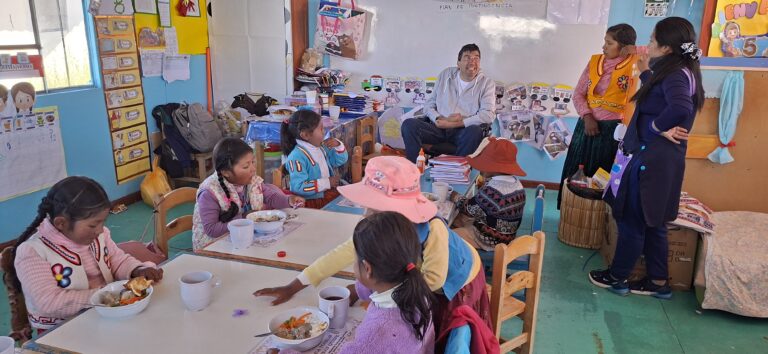
The material base is relatively modest, but well maintained. The classrooms are functionally furnished and create a calm and safe environment for the children. The extensive use of natural materials, local toys and teaching aids made by the teachers and parents themselves is impressive. Great importance is attached to learning through practical activities, games and participation in the life of the community, which allows to compensate for the lack of modern equipment.
One of the most serious challenges facing the kindergarten is its geographical isolation. Access to the islands depends entirely on water transport and is often difficult in adverse weather conditions. This affects the delivery of materials, access to training for teachers and the possibility of more frequent visits from educational institutions. Every morning, teachers pass by the Urus islands by boat and collect the children for kindergarten. After the end of the learning process, the children return the same way.
An additional challenge is the socio-economic difficulties faced by many families, as well as the need for children to participate in daily family activities from an early age.
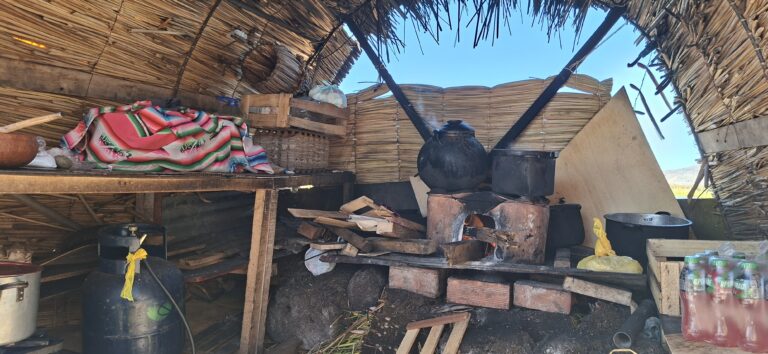
Despite these difficulties, the strong commitment of the parents is impressive. They do not perceive the kindergarten solely as a place for learning, but as an important part of the life of the community. Parents actively participate in the maintenance of the building and the yard, organize joint holidays, participate in traditional cultural events and assist in the development of teaching materials. They often share with the children knowledge about local crafts, fishing, agriculture and traditions, becoming natural partners of the teachers in the educational process.
The visit showed that successful preschool education does not depend solely on the material base or technology. Much more important are the relationship between the school and the community, respect for the cultural identity of the children, the active participation of parents and motivated teachers. The kindergarten on the islands of Lake Titicaca is a good example of how, even in conditions of limited resources, an inclusive and supportive educational environment can be built that prepares children not only for school, but also for an active life in their community.
The Universities of Cusco and Puno

The overall picture of intercultural education in the Andes would be incomplete without the universities in the big cities there. Once they were a “reserved territory” for the so-called “elite families” – primarily Creoles and mestizos. Today, more and more representatives of indigenous peoples are studying there and are teachers. Therefore, it is quite expected that intercultural education and the study of local languages (Quechua, Aymara, etc.) are also making their way into university halls.
The National University of San Antonio Abad in Cusco is one of the oldest universities in Latin America – it was founded in 1692. Today it educates 20-24 thousand students, primarily from the Andean regions. An increasing number of them are Quechua and representatives of other indigenous peoples. With each passing year, the university is becoming one of the centers of intercultural bilingual education – on the one hand, Quechua is studied in more and more faculties (although the main language of instruction is Spanish), and on the other hand – the university trains teachers for intercultural bilingual schools.

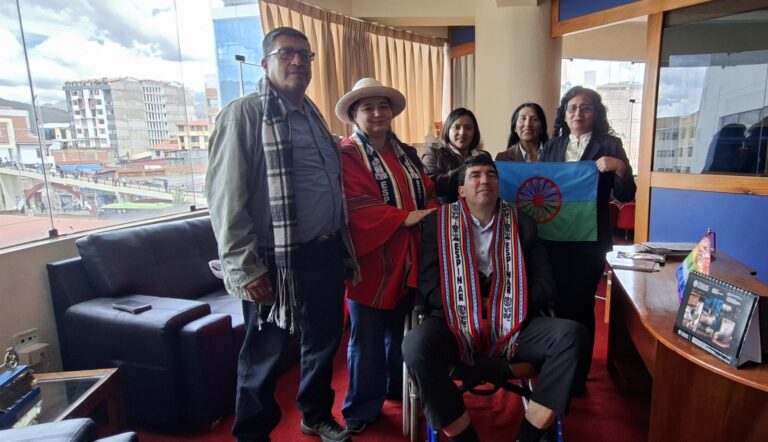
We spoke with professors from the University’s Institute of Languages. They explained that Quechua courses are becoming increasingly popular with students in all faculties. As expected, the faculties of pedagogy, anthropology, and history are the most popular. But more and more students in medicine, social work, and others are also studying Quechua. This is a way to work more effectively with Andean communities, as well as part of their identity – there is a process of strengthening Andean identity and pride in belonging to indigenous peoples. The Institute is also often sought after by teachers who want to complete postgraduate qualifications in IBO and teach in bilingual schools. In practice, the University of Cusco is one of the main sources for the qualification of bilingual teachers – in addition to the Institute of Languages, such teachers are also trained in the Faculty of Pedagogy. During the conversation with the management of the Institute, it became clear that the postgraduate qualification at IBE takes 1 year and the Institute/University does not offer more flexible forms of training.
The teachers were very interested in the experience of Bulgaria and Amalipe in introducing intercultural education, in particular – its connection not only with language, but also with culture. This trend is increasingly observed in Peru – Andean culture and its various forms are finding a place in IBS and even in the university.

The teachers were very interested in the experience of Bulgaria and Amalipe in introducing intercultural education, in particular – its connection not only with language, but also with culture. This trend is increasingly observed in Peru – Andean culture and its various forms are finding a place in IBU and even in the university.
In the discussion that followed, we were very pleasantly impressed by the fact that the students strive for modern knowledge and fulfillment, while at the same time being proud of their identity and the cultural diversity of Peru. The conversation with the young people filled us with hope that in Bulgaria we will soon have a much larger number of Roma students in various universities and majors who are proud of their identity.

After the visit, we spoke with Reynaldo (a Quechua from Puno) about the identity of the indigenous people and the presence of discrimination. He was convinced that the trend of assimilation in the Andes has already been overcome (of course, not completely). The reduction in manifestations of discrimination has led to a strengthening of pride in belonging to the indigenous peoples. The trend of assimilation has been overcome in the Andes, but not in Lima and the large cities on the coast. It is obvious that intercultural bilingual schools and universities play an important role in strengthening the identity of the indigenous peoples. An important challenge remains how to make IBO happen on the coast as well.
Authors: Deyan Kolev, Teodora Krumova
See more at:
Intercultural Education Beyond Borders: Lessons from Peru (Part I)
What Is Inter-cultural Bilingual Education in Peru
Peru at the End of 2022: Can Diversity be a Source of Development, not of Conflict