

On-line launch of the “Dream road” project
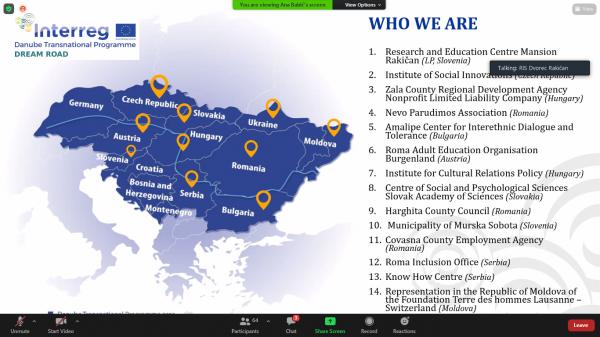
 Organized by the Rakičan Manor Research and Education Center, the online launch of the DREAM ROAD project (Danube REgion for improved Access and eMpowerment of ROmA Development) took place on Wednesday, December 2, 2020. As part of the online event, we presented the DREAM ROAD project, which is based on the inclusion and empowerment of the Roma community in order to improve functional, digital and information literacy. The project, which brings together 15 partners from ten Danube countries and lasts 30 months, focuses on overcoming the social marginalization of Roma and their unequal access to public services. Through the participation of all social actors, the involvement and mobilization of the Roma community and the wider society, it builds the foundations for integrated communities. The participants of the online event, which took place via the online platform Zoom, were addressed by dr. Robert Celec as the director of the public institution RIS Dvorec Rakičan, who directs the project as a leading partner, and pointed out that in recent years the public institution has established itself in the field of Roma issues as a contractor of numerous national programs and projects. “It is difficult, if not impossible, to implement programs aimed at the Roma without their involvement at all levels – from preparation to implementation. Otherwise, we will experience extreme distrust and dissatisfaction. ” The DREAM ROAD project also aims to highlight positive success stories, by collecting and exchanging good practices within the partnership. It also focuses on the establishment of computer-equipped community spaces for the acquisition of knowledge and support in education and work with
  municipalities and local communities. Daniel Grebeldinger, a representative of the Romanian organization Asociatia Nevo Parudimos, spoke about the challenges of Roma inclusion in the Danube region. While overseeing the inclusion of Roma issues in EU programs, he pointed out that too many times since the first demands for the introduction of national strategies by the EU, Member States have implemented Roma programs to meet Union requirements and achieve the desired indicators. “Civil society, Roma communities and institutions often fail not because of a lack of will, but because of a lack of qualified staff or resources.” In the current coordination of national recommendations for the preparation of the strategy at EU level, he recalled that it is crucial that representatives of civil society and organizations come forward with suggestions and comments. He also pointed out the severe hardship of Roma communities during the COVID-19 pandemic with the ban on mobility and the introduction of distance learning. Acquiring knowledge or educating the Roma community is the foundation of the DREAM ROAD project. The field of education was highlighted by Deyan Kolev, a representative of the Bulgarian institution Amalipe Center for Interethnic Dialogue and Tolerance. The organization was founded two decades ago by Roma students and still cares about improving the situation in the field of education – it works with 300 schools across the country, employs 30 Roma mediators. He highlighted poverty as a central challenge facing the Roma community during the epidemic. The epidemic also plunged into poverty those families who had previously lived in acceptable conditions. Furthermore, the professor of philosophy pointed out that we are facing a crisis of education, given the lack of adequate devices and internet connections in Roma settlements. Social distancing and restriction of movement, however, has an extremely negative impact on members of the Roma community who have lived off seasonal work, and this is not necessarily always tied to contracts. Among the good practices, the event also highlighted the program of social activation for Roma women “Trust yourself – Patja andi tute.”
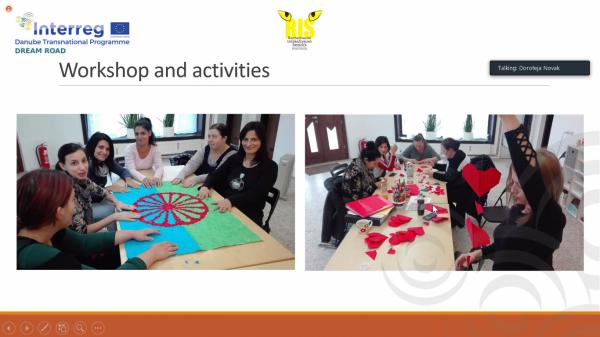 In his presentation, Jiri Danes from the Institute of Social Innovations focused on the presentation of social innovations and how communities can make better use of them. He pointed out that it is also important that these approaches are adopted by the institutions and their superiors. Roma are included mainly through programs for the unemployed. Doroteja Novak from RIS Dvorec Rakičan also presented the best practices of Roma inclusion. The best, of course, are those practices that can be successfully implemented in the long run. They offer several programs in Rakičan, and the main focuses are integration into successful socialization and education. One of the programs is a social activation program called Trust Yourself. The program will run for three years and target Roma Roma women. The program includes 10 groups of 15 women, which makes a total of 150 participants. The main objectives of the program are to reduce social exclusion and poverty and to improve their employability and life chances. The second project, which is in its final stages, is called the Green and Healthy Social Inclusion of Roma program. It lasted for three years, and the participants were Roma – both children and adult members of the community. The main objectives of the project are integration and poverty reduction, as well as improving employment opportunities. The pandemic also affected Roma communities in Pomurje. During the epidemic, project collaborators helped with both distance learning to students and the distribution of food packages. Two more examples of good practice in Slovenia were presented, namely Romani Kafenava in Maribor, the first restaurant with traditional Roma cuisine and Radio Romic, which broadcasts from Murska Sobota.
While trends at EU level have been leaning towards higher education statistics in favor of women for many years, in the Roma communities of the Danube countries it is women who are most burdened by limited access to education, traditional roles and care for younger family members, and unemployment and the inability to survive with dignity. The social activation program enables the participating members to gain knowledge and work experience, as well as a safe environment and informal socializing.
