
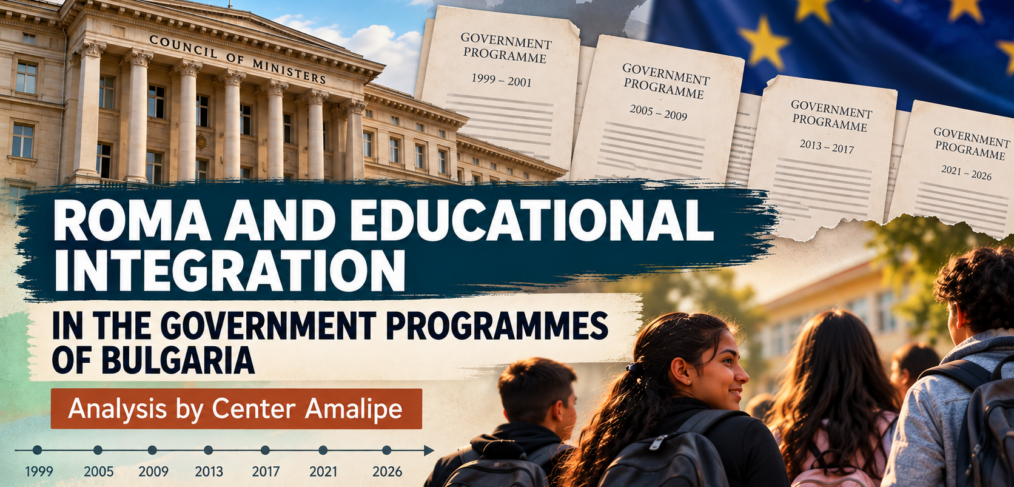
Roma and Educational Integration in the Programmes and Practices of Bulgarian Governments Analysis by Center Amalipe
For anyone familiar with Bulgarian reality and with the education system and practice, it is self-evident — “with unquestionable clarity” (Kant) — that educational integration in its many dimensions is essential for overcoming inequalities, achieving the broadest possible access to education and improving its quality. Equally self-evident is the need to achieve real progress in Roma integration. “Yes, but no,” as Petko Bochаров famously put it. Even a brief review of government programmes over the past 30 years clearly shows that Roma and educational integration were explicitly present in them until 2009, after which they “disappeared” and were replaced by broader terms such as “vulnerable groups”, “inclusive education” and similar concepts. The programme of the current government is no exception. At the same time, actual practices — particularly in education — have continued and have even introduced important new integration measures. What explains this discrepancy? Are there real policies for educational integration and Roma integration today?
According to various sources — including the population census and studies by the Council of Europe, the EU Agency for Fundamental Rights, the World Bank, the OECD and others — Roma account for between 4% and 10% of Bulgaria’s population. According to information from the Ministry of Education and Science and its national education information system, half of Bulgaria’s general schools and vocational high schools are schools with a concentration of vulnerable groups (1,126 schools), educating 182,440 students. To these we can add 491 kindergartens with 39,239 children. Given these figures, it should be self-evident that Roma integration and the educational integration of children and students from ethnic minorities must be a clearly articulated priority of every Bulgarian government.
This is not the case — or at least it is not clearly visible — in the programme of the current government. Its Education section contains no objectives or even references to intercultural education, desegregation or other important elements of educational integration; the term itself is absent. The only relevant objectives concern the introduction of a preparatory language class, diversification of language support, the establishment of a methodological centre for educational mediators, and increasing the number of Roma with higher education — the only place in the Programme where Roma are explicitly targeted. Roma and minorities are otherwise absent from the government programme.
The Radev Government Programme is not exceptional in this respect. The same omissions can be found in the programmes of the Zhelyazkov, Denkov–Gabriel, Kiril Petkov and Borissov I, II and III governments. There are partial exceptions, but they remain episodic: for example, the Zhelyazkov programme contains a single reference to desegregation; the Petkov government envisaged — and implemented — an expansion of educational mediators; and efforts to achieve full enrolment and attendance in the education system emerged as a major priority under Borissov III and were continued afterwards. Yet these measures remained outside the concept of “educational integration”, which is absent from the government programmes.
Explicit and clearly named support for Roma integration was characteristic of documents adopted before Bulgaria joined the EU. Ivan Kostov’s government, which clearly defined EU and NATO integration as a key national priority, had an “ethnically neutral” government programme, but it was the first to adopt a targeted document on Roma integration — the Framework Programme for Equal Integration of Roma into Bulgarian Society (1999). It is an example of successful advocacy and of listening to civil society: its adoption was preceded by an active Roma community campaign involving more than 80 organisations, which proposed a draft including desegregation of the so-called “Roma schools” and many other important elements. Subsequently, Western European partners, including European Commission President Romano Prodi, regarded the Framework Programme as an important sign of Bulgaria’s readiness for EU membership.
The trend towards explicit inclusion of Roma in government documents continued under the Sakskoburggotski government, which defined Roma integration / minority integration as one of its major priorities. The high point was the programme of the Stanishev government — “Programme of the Government of European Integration, Economic Growth and Social Responsibility”, adopted in 2005. It contained a dedicated section, “Integration of Minorities and Improvement of the Ethnic Model in Civil Society”. The government declared a policy of sustainable minority integration and explicitly referred to “the integration of minorities and, in particular, Roma”. In education, the programme went further, envisaging opportunities for Roma children to study alongside peers from the majority population, together with measures for equal access to quality education, changes concerning special schools, mother-tongue learning and others. In substance, this was a desegregation policy even where the word “desegregation” itself was not used. Roma also appeared in employment policy through vocational guidance for unemployed Roma, incentives for employers to hire Roma and measures against stereotypes towards the Roma population. In other words, the programme of the three-party coalition and the Stanishev cabinet did not merely “mention” Roma; it contained government policy that targeted Roma.
This was by no means a unanimous or even predominant view among senior government experts. Center Amalipe’s advocacy for Roma-targeted provisions in the Human Resources Development Operational Programme — which, in Bulgaria’s first programming period, also covered education — was initially met negatively. The proposals were eventually accepted and the programme became one of the main sources of funding for Roma integration after the European Commission’s Directorate-General for Employment supported them.
In parallel with the inclusion of Roma in government programmes, important sectoral strategies for Roma integration were adopted: the Strategy for Educational Integration (2004), the Health Strategy (2005), the National Programme for Improving the Housing Conditions of Roma (2006); Bulgaria became a founding participant in the Decade of Roma Inclusion (2005) and adopted an Action Plan; the Centre for Educational Integration of Children and Students from Ethnic Minorities was established within the Ministry of Education and Science, operating with state-budget funds (2006); and a number of other initiatives followed. Roma organisations repeatedly criticised the lack of large-scale practical action to implement these documents, arguing that they had been adopted primarily to demonstrate that Bulgaria met the Copenhagen criteria for EU membership. I have repeatedly voiced similar criticism myself, and I still believe there were grounds for it. Nevertheless, the explicit inclusion of Roma integration in numerous government documents was an important political signal. It was not followed by a large-scale integration policy, but that is a different question.
Another signal of intent was the creation of an administrative — albeit relatively “soft” — infrastructure. Bulgaria has never had an institution with executive powers specifically responsible for Roma integration, such as a ministry or state agency. Across governments and decades, the dominant concept has been that integration policies should be implemented by the relevant ministries and executive institutions, while coordination should be entrusted to a public council or another similar “soft” structure. In December 1997, and subsequently restructured in 2004 and 2006, the National Council for Cooperation on Ethnic and Integration Issues was developed as a body of the Council of Ministers in which, by design, political representatives of key institutions and minority NGOs were to participate. Its chair was a deputy prime minister, while one of its deputy chairs was elected by the participating civil-society organisations. Its rules assigned it significant powers, including participation in the inter-ministerial coordination procedure for acts of the Council of Ministers. These powers never became fully effective in practice, and Roma NGOs repeatedly criticised the Council’s lack of meaningful activity.
Nevertheless, during the initial period of its existence the Council was regarded precisely as a targeted body supporting and coordinating minority integration activities. It also had an administrative support structure — the Directorate for Ethnic and Demographic Issues — which at one point reached around 20 staff members. In parallel, a National Coordinator for the Decade of Roma Inclusion was appointed — a deputy minister / political appointee in the Ministry of Labour and Social Policy. The complex coalition relations within the three-party coalition produced a particular dualism in the coordination of integration policies: the Council and its Directorate, chaired by a deputy prime minister from the Movement for Rights and Freedoms, on one side, and the Decade Coordinator, a deputy labour minister from the Bulgarian Socialist Party, on the other. This affected coordination efficiency, but it nevertheless demonstrated political attention.
Bulgaria’s accession to the European Union marked a gradual change in policies towards Roma and minorities. They steadily disappeared from the government programmes of successive governments, regardless of which political party led them. This in itself signalled reduced political attention. Was this due to the entry of nationalist parties into Parliament and the gradual rise of anti-Roma discrimination, or to the disappearance of the need for Bulgaria to demonstrate strict compliance with the Copenhagen criteria? Whatever the answer, targeted Roma integration policies were gradually replaced by policies aimed at “vulnerable groups”, “social inclusion” and other much broader concepts. In education, the term “educational integration” was gradually displaced by “inclusive education”, understood mainly as addressing the needs of children with special educational needs and students with low achievement, but not encompassing issues such as desegregation, intercultural education or preserving the cultural identity of children and students from ethnic minorities.
Paradoxically, Bulgaria gradually moved away from specific / targeted policies towards Roma at the same time as the EU moved in the opposite direction and increasingly developed specific and targeted Roma policies. Yet the years after EU accession cannot be described as an unequivocal end to Roma-specific policies in Bulgaria. On the contrary, EU membership created conditions for more consistent and, above all, much better funded Roma integration policies. The absence of a specific Roma/minority integration priority from government programmes after 2009 was therefore more a sign of a lack of political courage than of the complete abandonment of such policies. Bulgarian reality — and the reality of Bulgarian schools — continued to require integration efforts and resources. After EU accession these developed in three main directions.
First, the European funds provided substantial resources that could — and in many cases had to — be used for Roma integration. Following successful advocacy by Roma NGOs to include Roma in the Human Resources Development Operational Programme, the Regional Development Operational Programme and the Rural Development Programme, implementation of these EU-funded programmes required actual integration activities. For the first time, relatively substantial financial resources became available. The first specific / targeted operations for Roma/minority integration were launched. During the 2007–2013 period, for example, the Human Resources Development Operational Programme financed six targeted operations, while indicators measuring effects on Roma were included across all programme axes.
These efforts continued in subsequent programming periods as a result of successful advocacy by Roma NGOs, support from the European Commission and, at times, understanding from national institutions. For 2014–2020/21, the European Commission proposed that Member States include in programmes co-financed by the European Social Fund the investment priority “socio-economic integration of marginalised communities such as the Roma”. Bulgaria accepted this proposal and included the priority in both the Human Resources Development Operational Programme and the new Science and Education for Smart Growth Operational Programme. In the following years the two programmes financed numerous projects by schools, kindergartens, NGOs and municipalities for Roma integration, including integrated operations supporting education, employment, social and health services and social housing for vulnerable groups.
Including Roma in the programmes for the third programming period (2021–2027) proved considerably more difficult. The Borissov III government — whose coalition partners included three nationalist formations — had an implicit intention not to include the targeted Roma investment priority in any programme. Amalipe and other organisations strongly objected and did not support the first versions of the Human Resources Development Programme and the Education Programme, appealing to the European Commission to ensure that Roma were included. After the Commission also insisted, both programmes explicitly incorporated the socio-economic integration of Roma and subsequently financed specific / targeted operations for Roma integration.
The second direction was linked to the EU Framework for National Roma Integration Strategies adopted in April 2011. After 2007 — including the first European Roma Summit organised by the European Commission in September 2008 — the EU increasingly required Member States to implement specific / targeted Roma policies. In June 2009 the Council of the European Union endorsed the Ten Common Basic Principles on Roma Inclusion, the second of which requires “explicit but not exclusive targeting”. The EU Framework for National Roma Integration Strategies followed precisely this principle and required all EU Member States to prepare national Roma strategies.
In Bulgaria, this was an inclusive process involving dozens of Roma organisations and experts. At their insistence, the National Strategy of the Republic of Bulgaria for Roma Integration was approved not only by the Council of Ministers, as initially intended and as previous practice suggested, but also by a Decision of the National Assembly on 1 March 2012. This was a highly important positive signal that made Roma integration a commitment for all institutions, including municipalities. Under the parliamentary decision, the report on implementation of the Roma Strategy was to be debated and voted on annually by the National Assembly. This potentially powerful mechanism was never used to its full extent, but it nevertheless existed. Another important consequence was the Strategy’s mandatory requirement that all municipalities adopt municipal Roma integration plans; in the following months, this did in fact happen. Thus, explicit targeted Roma integration policy continued despite its absence from government programmes.
In 2020 the European Commission adopted the new EU Roma Strategic Framework, followed by the Council’s Recommendation in March 2021, again requiring national Roma strategic frameworks from all Member States. This time the process at national level in Bulgaria was considerably more limited, and many Roma organisations declined to participate. On 5 May 2022, the Council of Ministers adopted by decision the National Strategy of the Republic of Bulgaria for Equality, Inclusion and Participation of Roma (2022–2030). Despite requests from Roma organisations, the document was not submitted for adoption by the National Assembly. An Action Plan for 2022–2023 and subsequently an Action Plan for 2024–2027 were adopted. The added value of these documents is relatively low: they largely summarise activities that the responsible institutions are already implementing, without assigning genuinely new measures — in other words, their value is primarily descriptive rather than prescriptive. Nevertheless, the existence of a National Roma Strategic Framework and an Action Plan maintains a political commitment to integration policies.
The third important direction consists of measures that have a substantial impact on Roma policies even when they are not formulated explicitly or as targeted measures. A clear example is the effort to achieve full enrolment and attendance in the education system. This became one of the main priorities of the Borissov III government and was continued by subsequent governments. The Council of Ministers established an inter-institutional outreach mechanism and regional and local outreach teams; Council of Ministers Decree No. 100/2018 was adopted; high-level political attention and financial resources were invested. None of these documents explicitly referred to Roma children, but the policy had — and continues to have — a positive effect on educational integration, access to education and Roma integration more broadly.
Another example is the introduction of the position/profession of educational mediator. Initially this was financed through the Education Programme, particularly through the “Support for Success” project. After mediators demonstrated their high added value, and following advocacy by Amalipe and other Roma organisations, governments continued their financing through a national programme (2022–2023) and then through the state budget (from 2023 onwards). Many other examples can be given in education. Since 2018, for instance, the Ministry of Education and Science has provided relatively substantial resources to schools and kindergartens with a concentration of vulnerable groups. Vulnerability is determined not by ethnicity but by parents’ educational status, with education below upper-secondary level used as an indicator. In this way the state budget supports schools and kindergartens facing real challenges in enrolment and access to education. These practices were introduced under Borissov III and continued by subsequent governments even though their programmes contained no commitment to Roma integration or educational integration. Formally, these practices are not Roma policies; in reality, they have a major impact on Roma inclusion.
It is also important to note that educational integration and its constituent elements were included in policy documents following advocacy by Roma and pro-Roma organisations. As an unwritten rule, education institutions initially did not always recognise their importance, but subsequently supported them. The Preschool and School Education Act, for example, contains numerous provisions supporting the cultural identity of children from different ethnic groups, anti-segregation provisions — including bans on forming ethnically homogeneous classes and groups in ethnically mixed schools and kindergartens — and a State Educational Standard for civic, health, environmental and intercultural education.
Another example is the Strategic Framework for the Development of Education, Training and Learning in the Republic of Bulgaria (2021–2030). The initial version proposed by the Ministry of Education and Science did not contain explicit provisions on educational integration. This changed during the public consultation: following proposals by Amalipe and other organisations, Priority Area 5 — “Effective Inclusion, Lasting Participation and Educational Integration” — was added. It integrates the main themes of educational integration of children and students from ethnic minorities: intercultural education, desegregation, full enrolment and attendance, work with parents and others. Although the Ministry had not initially included these themes, they were incorporated following proposals from civil society.
In conclusion, clearly articulated and explicit Roma integration policies were included in government programmes and other policy documents in the run-up to Bulgaria’s accession to the EU. We can state with a high degree of confidence that they contributed significantly to meeting the Copenhagen criteria and that the accession process was probably an important incentive for articulating a specific Roma policy in Bulgaria. The principal weakness of these documents and of the targeted approach was the low level of political determination to implement them and to invest financial resources. The documents existed and were often of high quality, but in practice they did not produce sufficiently substantial change.
After EU accession, Roma, Roma integration and educational integration became increasingly invisible in official government programmes. The specific targeted approach continued through the National Roma Integration Strategy and through EU co-financed operational programmes. These added relatively substantial resources for integration policies and additional requirements in this field.
The so-called mainstreaming approach is visible in the incorporation of measures such as educational mediators, support for work with vulnerable groups and similar instruments into general education policies. It is relatively easy for politicians and the wider public to accept. The approach can produce good results, especially when measures are well designed and reach a broad range of final beneficiaries. At the same time, it has serious limitations in relation to key educational-integration issues: preservation of ethnic identity, intercultural education and desegregation remain outside the scope of a purely mainstreaming approach. Yet these are issues without which educational integration — and Roma integration — cannot be achieved.
Active advocacy by Roma NGOs, schools and other education institutions, together with support from the European Commission and other international actors, remains an important prerequisite for progress in Roma policies. This is true not only for Bulgaria, but for most other countries as well.
Looking ahead: what needs to be done?
- Planning EU funds for 2028–2034
At present, hardly anyone can say with certainty what the final format and financial allocation for Bulgaria will be in the next programming period. The European Commission presented its ideas in July 2025 and the European Parliament has also adopted a position; negotiations with Member States are ongoing. It is important that the new programmes include the investment priority “socio-economic integration of marginalised communities such as the Roma” and Roma policies more broadly. This is crucial both for financing and for political weight. Key operations for Roma integration / Roma equality, inclusion and participation should be planned, with an appropriate budget — realistically, EU funds will remain the principal source of financing because the state budget has only a partial commitment — and with clear indicators.
Roma NGOs as beneficiaries
NGOs should remain potential beneficiaries of operations for Roma integration and social inclusion. Previous decades have clearly demonstrated the important role played by Roma and pro-Roma NGOs in overall Roma policies and activities. The main barriers to NGO participation in EU programmes must therefore be addressed, including the lack of advance payments for NGO projects and the application of state-aid/de minimis rules to civil-society projects even where no market or competition exists. Roma NGOs should also participate actively in preparing the new EU programmes. A positive practice from previous periods was the creation of a specific group of “organisations working with marginalised communities and ethnic minorities” to nominate representatives to programme drafting groups and Monitoring Committees. This practice should continue without being diluted by adding unrelated categories.
- Improve the National Strategy for Equality, Inclusion and Participation of Roma (2022–2030)
Several steps are possible: institutional reform of the National Council for Cooperation on Ethnic and Integration Issues; structuring the Council at two levels, with the higher level having stronger consultative and coordination powers and clearer membership criteria; adding specific measures to combat anti-Roma discrimination, segregation and hate speech; and adopting the Strategy by a Decision of the National Assembly.
- Support civil-society development and create an enabling environment
This concerns not only Roma organisations but the NGO sector more broadly. Bulgaria needs to invest national financial resources in civil-society development. Many European countries do so, and some of Europe’s best-known and most sustainable foundations benefit from national financing. Bulgaria remains an exception: for years the state budget has earmarked only a symbolic amount for civil society, while an effective mechanism for spending even these limited funds has not been put in place. The Council for Civil Society Development also needs stronger political support. It includes active organisations elected through a national procedure open to NGOs, but it has still not achieved the desired impact, largely because of limited political engagement. Finally, hate speech against civil-society organisations and against the Roma community must be curtailed. Politicians are an important factor in this regard.
Author: Deyan Kolev
See also
Civil Society and NGOs in the 2026–2030 Governance Programme: Partner or Merely a Participant?
The Radev Cabinet’s Governance Programme – What Does It Envisage for EU Funds?
The Radev Government’s Governance Programme – What Is Envisaged for Education and Are Roma Included?