
The Radev Government’s Governance Programme – What Is Envisaged for Education, and Are Roma Included?
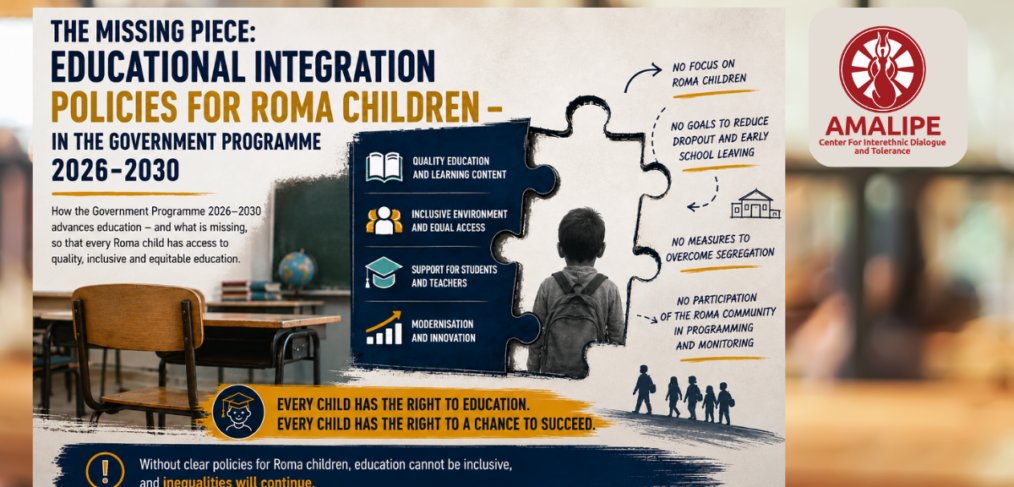
On 12 August, the Council of Ministers adopted Bulgaria’s Governance Programme for 2026–2030. The document is comprehensive and extensive – 208 pages covering almost all areas of public life and setting out objectives and expected results. Somewhat surprisingly, education is one of the areas developed in considerable detail. What is particularly striking, however, is the evident absence of an important part of the education policies pursued so far: intercultural education, desegregation, support for schools with a concentration of vulnerable groups, educational mediators, and educational integration are either absent or almost entirely absent. What have they been replaced with? Is their absence accidental? What can be done to address these important gaps?
What Does the Governance Programme Envisage for School Education?
The Government’s Governance Programme for 2026–2030 largely builds on policies already established in Bulgarian education, while at the same time introducing several new or more strongly articulated priorities. The main direction is towards improving quality and measurable educational outcomes, combined with expanding access and support for children and students.
The quality of education and changes to curriculum content are among the leading priorities – as was also the case in the programmes and activities of previous governments. Changes are envisaged to the state educational standards and curricula, with a stronger emphasis on key competences, basic skills, the practical application of knowledge, cross-curricular integration, and education in values and virtues. Changes to assessment are also envisaged – moving from an approach focused primarily on measuring knowledge towards a system that tracks acquired skills and students’ progress. These are not new priorities; they reiterate what previous leaderships of the Ministry of Education and Science have stated repeatedly, without providing a clear indication of how these objectives will be achieved.
Particular emphasis is placed on the formative role of the school and the development of values. The Programme envisages introducing the subject “Virtues and Religions” as part of the compulsory curriculum, with June 2027 set as the planned deadline for its introduction in the 2028/2029 school year. This proposal was also put forward in April 2025 and prompted polarised public reactions – support from the Patriarch, the Grand Mufti and the Bulgarian Orthodox Church, opposition from parents and civil society organisations, and concern among teachers and school principals, particularly in ethnically and religiously mixed regions.
The second major group of policies concerns equal access, enrolment and overcoming educational inequalities. The Programme envisages dropout prevention, full enrolment of children of compulsory school age, early identification of educational deficits and timely support – priorities that education professionals have encountered repeatedly under different Ministers of Education. One particularly specific measure is the introduction of a preparatory language class before Grade 1 for children who are not sufficiently proficient in Bulgarian, with a deadline of September 2027. This measure was also included in the amendments to the Pre-school and School Education Act proposed by the previous government in July 2025. The proposed measure was met with differing reactions from various stakeholders – some supported it, others opposed it, while still others remained unclear as to what exactly its implementation would involve.
In a highly tentative manner, it can be said that the policy of supporting schools with a concentration of vulnerable groups is also being partially continued, including through an objective to reduce the number of schools classified in Group V, as are the policies concerning educational mediators. The Programme envisages establishing a methodological centre and increasing the number of trained mediators. It also provides for expanding the network of central and protected schools and ensuring free transport for all children and students who need it. These, too, are priorities that have existed for many years. The current Governance Programme devotes significantly less attention to them and is far less specific, as we explain below.
Teachers and other educational professionals remain a central element of the policy. Here, there is particularly clear continuity with the policies pursued in recent years. The Programme reaffirms the commitment for the remuneration of pedagogical specialists to reach 125% of the average salary, with the achievement of this target postponed until 2030. At the same time, it provides for professional development, assessment of the impact of professional development, psychological support, supervision, mentoring, and prevention of professional burnout. An average of around 1,150 new teachers per year is expected to be recruited. Training is also envisaged in the competency-based model, STEM, artificial intelligence (AI), and digital technologies.
The Programme also continues the policy of inclusive education, providing for more resource teachers, speech and language therapists, psychologists, social pedagogues and teaching assistants, as well as individual learning plans, adaptation of curricula and assessment, and improvements to the accessibility of the physical environment. In line with the negative trend of previous years, inclusive education is addressed primarily as support for children with special educational needs (SEN) and learning difficulties. This time, educational integration is entirely absent, together with its key priorities such as desegregation, intercultural education and others – we discuss this in greater detail below.
Another major priority is the modernisation of the school environment – transition to single-shift schooling, construction and reconstruction of schools, energy efficiency, new sports halls and sports grounds. In vocational education, the Programme envisages expanding dual education, introducing new curricula, increasing practical training in real working environments, and strengthening links with businesses. As can be seen here as well, the Governance Programme continues important priorities inherited from previous governments, which is an important indication of their significance.
What Does This Mean for Education Professionals?
For school principals, the Programme means a continuation of policies aimed at school modernisation, transition to single-shift schooling, work with vulnerable students, recruitment of specialists, and more systematic monitoring of educational outcomes. For teachers, higher salaries are expected (although it is not particularly clear when these will actually be achieved…), alongside continuing professional development and new requirements related to the competency-based model, digital technologies, AI, and working with different groups of students. For pedagogical specialists and educational mediators, the Programme envisages an expansion of the support system, while schools are expected to have more opportunities to work with parents, specialists and communities. Schools with a concentration of vulnerable groups may have grounds for concern (these account for half of all general education schools and 44% of vocational high schools), but at least at the level of stated policy, support for them will continue – albeit without clearly defined parameters.
In this sense, the Governance Programme is both a programme of continuity and one of several more visible changes: it retains the main lines of development in education pursued in recent years – increasing teachers’ salaries, inclusion, enrolment, digitalisation, STEM, innovation and infrastructure modernisation – while placing greater emphasis on functional skills, education in values and religion, the preparatory language class, and monitoring students’ actual progress. It is against this background that we should also consider what has not been continued from the existing policies on educational integration, desegregation, intercultural education, and work with the Roma community.
What Is Missing from the 2026–2030 Governance Programme in the Policy on Educational Integration?
A comparison between the Strategic Framework for the Development of Education, Training and Learning in the Republic of Bulgaria (2021–2030), Programme “Education” 2021–2027, and the 2026–2030 Governance Programme reveals a significant narrowing of the policy on educational integration in the latter document. The Governance Programme retains commitments to equal access, enrolment, dropout prevention and support for “vulnerable groups”, but does not carry forward a number of specific policies included both in the Strategic Framework and in the Programme “Ëducation”.
First and foremost, educational integration is no longer included as a separate policy objective. The Strategic Framework contains a dedicated Objective 5.6, “Educational integration of children and students from vulnerable groups, including Roma, asylum seekers or beneficiaries of international protection, and migrants”. In it, educational integration is treated as a comprehensive policy encompassing not only access to education, but also overcoming segregation, working with parents and communities, intercultural interaction, and support for teaching and non-teaching staff. A similar priority is also included in the Programme “Ëducation”, whose first Priority Axis is “Inclusive Education and Educational Integration”, supporting measures for the introduction of intercultural education, desegregation and the prevention of secondary segregation. The Governance Programme contains no comparable strategic objective. Instead, it uses more general concepts such as “vulnerable groups”, “children at risk”, “educational inequalities” and “equal access”. Moreover, nowhere does the Governance Programme refer to ethnic groups, ethnic minorities, Turks or Roma. They have been replaced by the much vaguer concepts of “educational inequalities”, “children at risk”, “vulnerable groups” and “insufficient proficiency in Bulgarian language”. This might be appropriate for a country without ethnic minorities (Japan, for example, but not Bulgaria), or for Bulgaria in the early 1980s (on the eve of the so-called Revival Process)…
The most significant omission concerns desegregation. The Strategic Framework identifies the continuing segregation of individual schools as a specific structural problem, and the policies it envisages include “promoting school desegregation” and preventing secondary segregation. The Education Programme turns this policy into a concrete instrument through procedures for comprehensive municipal-level programmes for desegregation, prevention of secondary segregation and combating discrimination, including work with parents, communities, educational mediators and school teams. These policies continue to be implemented during the Programme’s period of operation.
In the Governance Programme, however, desegregation and secondary segregation are not identified as distinct problems or objectives. There is no commitment to desegregation programmes, work with receiving schools, prevention of secondary segregation, or the use of transport as an instrument for desegregation. Instead, the Programme sets an objective of having “more supported schools with vulnerable groups” and “reducing the number of Group V schools to below 485”. In practice, this is unrelated to desegregation.
The target itself is particularly paradoxical: currently, there are 384 Group V schools (i.e. schools where parents have the lowest educational attainment). If Group V kindergartens are added, the total reaches 487. In other words, the target refers not only to schools, but also to kindergartens. It is hardly ambitious: even at present, the target figure has essentially already been achieved (“we fulfilled the five-year plan not in three years, but in one day!”).
This objective is not in itself equivalent to desegregation: reducing the number of schools with the highest concentration may result from various processes and does not show whether students actually gain access to a more diverse and higher-quality educational environment. Quite the opposite – most Group V schools and kindergartens are located in villages and are not subject to the process of desegregation.
The second major omission is intercultural education. The Strategic Framework emphasises tolerance, respect for cultural differences and effective intercultural interaction, and envisages overcoming negative attitudes related to ethnic origin and cultural identity. Intercultural education is perhaps the most important means of achieving this. It is also embedded in the Pre-school and School Education Act, including through Standard No. 13 on civic … and intercultural education. The Education Programme further develops this policy through a dedicated procedure for promoting intercultural education through culture, science and sport. This was the first competitive project-selection procedure launched under the Education Programme.
The Governance Programme contains no distinct policy on intercultural education. It provides language support for children who do not have a sufficient command of Bulgarian, as well as a general formulation concerning the integration of children “from different linguistic and cultural backgrounds”. (The concept itself is innovative and unique – children may have an ethnic background, but the Programme does not address this and instead emphasises a linguistic and cultural background, something no one has previously considered in this way.) This is, however, a narrower concept: language support cannot replace intercultural education, which seeks to foster interaction between different groups and to change attitudes, stereotypes and relationships.
Moreover, introducing a language class could, in itself, also become a measure of ethnic assimilation (the above-mentioned Revival Process likewise placed emphasis on acquiring the Bulgarian language, supplemented by a Bulgarian ethnic identity). The authors of the language-class proposal presumably do not have this in mind, but without intercultural education there is indeed a risk of drifting towards assimilation. When the Council of Ministers and the Ministry of Education and Science proposed a preparatory language class in 2025, Center Amalipe raised another criticism as well: if pupils are allowed to repeat this preparatory year, some children could be nine years old when they finally walk through the classroom door marked “Welcome to Grade 1”. This could become a precondition for their rejection by the other first-graders, who would be two years younger, and for their subsequent dropping out of school.
The third omission is a specific policy addressing Roma children and students. The Strategic Framework explicitly includes Roma under Objective 5.6. The Education Programme also identifies Roma as part of the target groups of educational integration measures. The European Commission itself has also established as an investment priority the “socio-economic integration of marginalised communities such as the Roma”: this is the only case in which the name of an ethnic group has been included in a European regulation.
In the Governance Programme, the term “Roma” is virtually absent from school education policy. This does not mean that Roma children are excluded from measures targeting “vulnerable groups”, but it does mean that the specific barriers faced by Roma students – including segregation, discrimination and the need for work with the community – are no longer visible as distinct policy problems. It is telling that Roma are specifically mentioned in measures concerning higher education, but not in the main school education policy. As noted above, the Governance Programme does not acknowledge the presence of Roma in Bulgaria: the term does not appear in the Programme’s main sections.
The fourth omission is a systematic policy on educational mediators. The Strategic Framework envisages the development of a network for professional support and exchange of good practices among educational mediators and other professionals, as well as the development of their professional skills for working with families. The Education Programme uses mediators as a concrete resource in a number of operations, including work with students and parents from vulnerable groups and desegregation activities.
A particularly important positive development in recent years has been the provision of state-budget funding for the salaries of educational mediators through Article 52a of the Ordinance on Financing. Another important achievement is the introduction of the profession of “educational mediation”, together with opportunities for vocational training for mediators. Most of these developments were achieved following advocacy by Center Amalipe, but also with the support of previous Ministers of Education and Members of Parliament.
In the Governance Programme, mediators are mentioned only as an expected result: “an established methodological centre and more trained educational mediators”. There are no quantitative targets, no commitment to sustainable financing or appointments, no provisions for professional development, and no connection made between mediators, desegregation and work with communities.
The fifth omission is the comprehensive approach to schools with a high concentration of vulnerable groups. The Governance Programme rightly recognises the need to support these schools and sets a quantitative indicator concerning Group V schools. This is a positive step and represents a level of specificity that is absent from the Strategic Framework. However, the Programme does not define how this change will be achieved.
There are no concrete instruments for additional financing, work with parents and communities, teacher training, mediators, intercultural education or desegregation. Thus, the number of schools is measured, but sufficiently clear indicators are not provided for changes in educational outcomes or in the composition of the school environment.
Of particular importance is the absence of a commitment to continue funding under Article 52a of the Ordinance on Financing. This funding enables schools with a concentration of vulnerable groups to receive additional resources for the salaries of educational mediators, additional training for students, outreach visits carried out by enrolment teams, and additional incentives for teachers. This funding is especially important for smaller rural schools (750 rural schools receive support under Article 52a), where it can be a prerequisite for the very survival of schools with smaller numbers of students.
In conclusion, we can say that the Governance Programme does not abolish the policy concerning vulnerable students, but it “dilutes and obscures” it as a specific policy of educational integration. It retains the universal instruments – enrolment, dropout prevention, language support, transport, specialists and support for schools with vulnerable groups – but leaves outside its strategic horizon the structural instruments embedded in the Strategic Framework and the Education Programme: desegregation, prevention of secondary segregation, intercultural education, a specific policy towards Roma, and a systematic policy for educational mediators. Support for schools with a concentration of vulnerable groups remains largely declarative, with no specific parameters set out, including for protected and central schools.
This creates a risk that after 2030, when the Education Programme comes to an end, there may be no sufficiently clearly articulated national commitment to continue precisely these policies. The question, therefore, is not whether the Governance Programme contains measures for vulnerable children – it does. The question is whether it contains the full range of educational integration policies that Bulgaria has already adopted through the Strategic Framework and is implementing through the Education Programme. The comparison shows that the answer is no.
It is difficult to speculate whether this negative development is due primarily to a lack of political vision or to the inability of administrators and politicians to formulate as policy objectives and expected results what is needed for educational integration and school education. Personally, I hope that the political class has no intention of pursuing a new Revival Process or assimilationist policies. But, as the well-known saying goes, “The road to hell is paved with good intentions”: we must all protect our politicians and the education system from half-thought-out and entirely meaningless actions.
Author: Deyan Kolev